Do District 65's SAP Committees Violate the Open Meetings Act?
The District 65 Board uses closed session meetings to punt on the hard questions
FOIAGRAS is a free newsletter run by Tom Hayden (FOIA GRAS LLC) that explores various topics in local Evanston (and now North Suburban Chicago) Governance. I publish and share all my data and reports. Subscribing is free, so please subscribe or share. Email (tom@foiagras.com) or comment with issues or mistakes.
Student assignment planning (SAP) is a core function of a School Board. It is codified in Illinois State Law (105 ILCS 5/10-21.3) and the School Board Policy. It’s also just intuitively a main function for electing school board members - determining which students go to which schools and drawing boundaries is a core policy-making function.
If you were at the Board meeting on Monday, you witnessed the Board and Administration referencing SAP committees used to make the hard decisions regarding school closures. At the start of the meeting, Dr. Turner stated;
Decisions lie ahead as it relates to school consolidation in District 65. Beginning this fall the district will engage in the third phase of our Student Assignment planning and will utilize the data and recommendations from SAP One and Two, our Master facility plan, and enrollment information. We will continue to convene a community-based committee to answer questions based on this data that will support implementation plans around school consolidations and programming placement all from student centered equity and financial lenses
Towards the end of the meeting, Board Member Salem chimed in and you can listen to his comments here (update: I had the wrong Youtube timestamp link here!) regarding activating SAP3 immediately.
First, some background on the SAP committees. Since 2021 there have been two committees.
SAP1 (February 2021 - March 2022) - SAP1 ended with the recommendation to close Bessie Rhodes and open a new K-8 school in the Fifth Ward.
SAP2 (February 2023 - October 2023) - I don’t know how or where SAP2 concluded, since meeting minutes are only available through October 2023.
Consider the following:
SAP1 had two board members on the committee.1 SAP2 had zero board members on the committee when it was founded.2
Neither SAP committee has public meetings. However, limited meeting minutes are posted online. But, there is no indication that the SAP committee follows best practices regarding recordings, public hearings, and approval of minutes.
Therefore, SAP Committee meetings are essentially closed.
The District has other committees that meet all the time and follow public best practices: finance, liason, curriculum, grounds, and so on. So does the City of Evanston, which has dozens of committees that include elected officials, staffers, and private citizens.
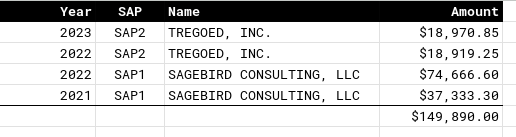
Both SAP1 and SAP2 had out-of-state consultants involved in the committees. The total cost for those consultants was around $150k. The Roundtable wrote about Sagebird and the relationships with Dr. Horton. It’s unclear what role the consultants play in the process because the meetings are essentially closed.
The ISBE gave a “Those Who Excel” award to the head of the SAP committees. You can read the nomination letter from ETHS Board Member Monique Parsons.3
The purposes of the SAP committees themselves are very confusing and include language indicating they are advisory committees and they are to advise the board, and not to make decisions. But I was at the Board meeting on Monday, and certainly get the sense that the Board takes their advice as final and not worthy of continued discussion. The Bessie Rhodes parents can certainly check me on this.
I look at the SAP process thus far and see (another) attempt to circumvent the Open Meetings Act. Instead of having public hearings and discussions on these important topics the Board is responsible for, they can appoint staff members, former board members, and friends to act as a proxies.
There is also a compelling argument that the SAP committee is a “public body” under the definition of the Open Meetings Act;
Governmental Function and Advisory Capacity: The SAP committee has a significant advisory role in a core function of the School Board. It’s recommendations are taken seriously by the School Board.
Creation under Public Body Authority: Since the SAP committee was established by the school District and falls under the District's jurisdiction, it should be considered a subsidiary body of a recognized public body. 4
Public Funding and Expenses: The expenditure of significant public funds (approximately $120k) for the consultants suggest that the committee expends tax revenue, which aligns with the characteristics of a public body under the OMA.
I believe the SAP committee should adhere to the same requirements of the OMA as the finance or curriculum committee, including holding open meetings, providing public notices, and ensuring transparency in its proceedings. Furthermore, if there were recordings of these meetings taken, those meetings should retroactively be made available to the public.
This is a tricky one because technically there are three board members on that committee. However, Ms. Kartha’s term ended on 4/2021 and Ms. Weatherspoon’s term began in 6/2021.
They had one board member on the committee after Omar Salem won his election in April 2023.
This raises an even weirder OMA question - what are the implications of having 2 board members from D65 and another board member from D202 in the meeting?
Public Body Includes: All legislative, executive, administrative, or advisory bodies of the State, counties, townships, cities, villages, incorporated towns, school districts, and all other municipal corporations, boards, bureaus, committees, or commissions of the State, and any subsidiary bodies of any of the foregoing.