Monday D65 Board Meeting: $200 Million in Near-Term Facilities Needs
Also: federal audits, tablets, and short-term financial issues
District 65 Board meets tomorrow, Monday, March 23 at 6:00 p.m. The agenda is large and covers a range of things from discipline to Head Start to facilities. Here’s a preview of some of the items.
$598.2 Million in Facility Needs — With Caveats
The biggest item on the agenda is a discussion about facilities. Chicago architectural firm, StudioGC will present its Combined Master Facility Plan and 10-Year Health Life Safety Report, commissioned in September 2025.
The headline number is big: $598.2 million but requires some unpacking.
First, the timeframe: that figure spans 49 years.
Second, two buildings in the report — Bessie Rhodes and Kingsley — are already slated for closure. Back those out and the total drops to roughly $538.9 million — or about $358 million in 2025 dollars.
The near-term picture is significant. The report uses a metric called the Facility Condition Index (FCI) — the ratio of estimated repair costs to a building's total replacement value — to rate each school's condition. StudioGC's scale runs from Good (11–20%) through Fair (21–40%) to Poor (41–60%), with anything above 60% in "consider replacement" territory. Over the seven-year window from 2027 through 2033, the near-term figure excluding Bessie Rhodes ($9.2M) and Kingsley ($11.9M), is $208 million.
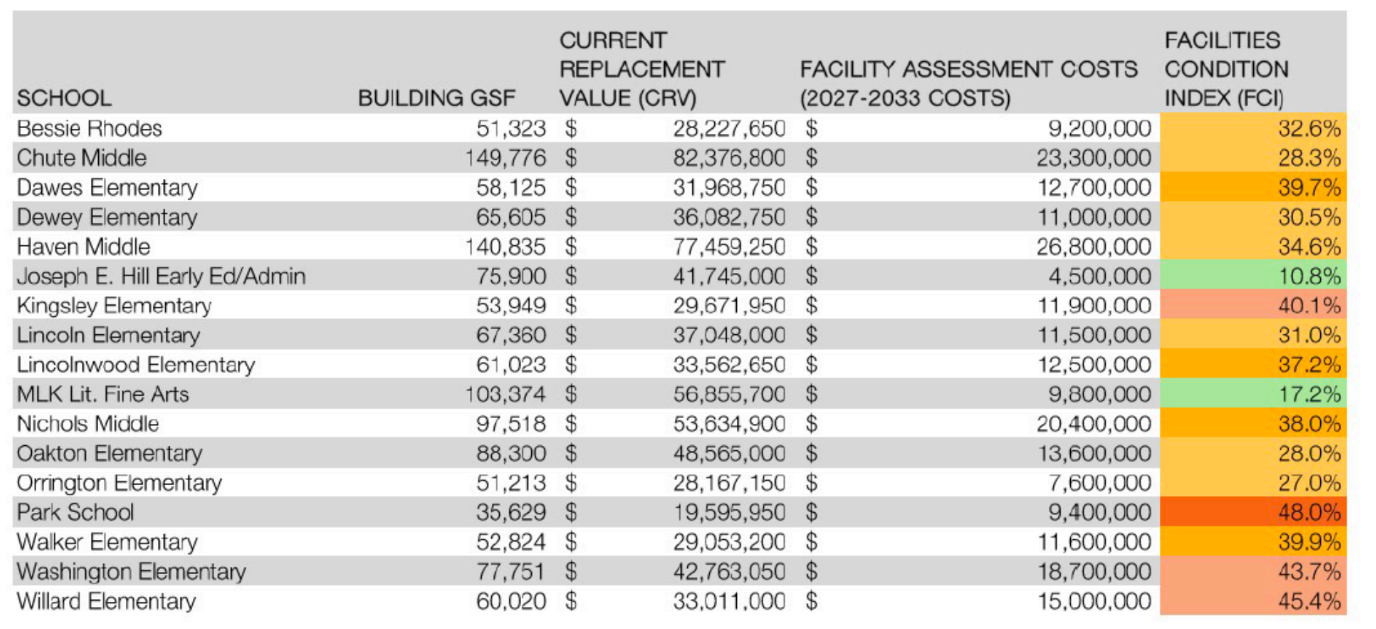
One thing that stands out is Park School - Park is a joint project between District 65 and ETHS and educates some of Evanston’s most vulnerable students. It also has the lowest FCI score in StudioGC’s analysis. Soon, D65 and ETHS are going to have to figure out a path for those kids.
Last summer, D65 hired a real estate advisory company (MPact) to assess every elementary school property and estimate property values. That Property Assessment Submission, from September 2025, covered 13 school sites and is a useful read on overall property values.
There's also a notable spike in 2034: the year-by-year table shows $131.7 million in projected costs in that single year. The report uses geothermal as the baseline for heating and cooling — the memo explains why:
"The cost estimates have been developed using the most expensive of the three options (geothermal) to reflect the District commitment to sustainability, the strongest return on investment and to capture the maximum funding needed."
A cheaper HVAC option would bring the overall number down.
This is not a new problem — just a bigger number. The Cordogan Clark Facilities Master Plan, presented to the Board in March 2022, identified $188 million in building deficiencies in 2021 dollars. Its summary slide concluded that "Recommended Potential Facilities Improvements have been Identified to be in the $275M to $300M Range"
It also noted D65's buildings were, on average, 77 years old with only limited renovations.
My thoughts: this is obviously bad but I think there is a path through this. Consider the top level facts:
The near term figure is about $200 million (if you back out Bessie Rhodes, Kingsley, and Park School)
Park School is a joint project with ETHS and should be part of a different conversation about special education services in Evanston.
District 65 brings in about $180 million per year in tax revenue. Almost all of that goes towards operations but with the SDRP, there are theoretically plans to put aside more for capital improvements. Unlike many distressed places, Evanston has a strong tax base that is not going anywhere anytime soon.
The Foster School opens next year and is coming in under budget. The District has the talent to be able to build and renovate. We have at least one new facility. That’s one better than no new facilities. I’ve been the most critical person in Evanston regarding the funding, but let’s work with what we have.
A referendum, like the one I suggested in 2025 would probably be on the order of $100 million and would reduce the gap. I think there are reasons to be excited about renovations on both the north and south side of town.
Federal Head Start Program
The Head Start program is a federal early childhood program for low-income families, funded by the U.S. Department of Health and Human Services (HHS). HHS is currently run by a guy who once dumped a dead bear in Central Park.
On Monday, the Board is voting on a change-in-scope request to cut funded enrollment from 129 to 102 seats — while converting a half-day classroom to full school day. The district's $2 million grant would shrink by $400k with the reduction, but D65 is asking to keep that money, arguing costs outpace the per-child grant rate:
Teachers, Teacher Assistants, Health, and Nutrition roles belong to District bargaining units. As each bargaining unit negotiates its contract, unionized salaries outpace the Head Start budget.
Most interesting to me: the Board received a notification that their expenses were “randomly” selected for a federal audit: the FY2026 Improper Payment Review. 150 programs nationwide were chosen this year under the Payment Integrity Information Act of 2019 and District 65 just happened to be selected.
In the audit, D65 has to hand over a list of every expense during FY2025 (October 2024 – September 2025). You can see a sampling on the SY2025 financial report, which overlaps most of this timeline. Federal reviewers then pick about 10 “random” transactions to examine closely, requesting backup documentation — receipts, contracts, payroll records, invoices, bid documents.
Relevant to this: D65 has been managing a long-running Department of Education Office of Civil Rights (OCR) complaint, originating from a 2021 complaint by a teacher. The first Trump administration's OCR issued an undated, unsigned Letter of Finding in early 2021 concluding that D65's "Beyond Diversity" professional development training violated civil rights law; the Biden administration then suspended the complaint shortly after taking office without formal resolution. In 2025, the second Trump Administration, reopened the investigation.
Recall that the current administration's Department of Education OCR Office is now run by Craig Trainor — former counsel to Rep. Jim Jordan, under whom the OCR issued a Dear Colleague letter in February 2025 threatening to pull federal funding from districts with DEI programs.
Student Device Purchase
The Board will vote on the student device purchase for SY26-27: 1,231 iPads and 1,295 keyboard cases. The original request was for 1,300 iPads; the number was trimmed after tightening enrollment projections. The Board will be considering alternative options including shared carts.
I've covered this in depth over the past two weeks — what the district's $3.9 million/year technology operation consists of and why unwinding the 1:1 iPad program is harder than it looks. More than 1,250 parents signed a Screen Sense Evanston petition calling for fewer screens in classrooms.
In advance of Monday’s vote, Screen Sense Evanston put out a newsletter asking parents to photograph their kids' screen time usage data and upload it to a shared Google folder. Their argument is that the district claims it doesn't have actual classroom screen time data, and Screen Sense wants real numbers to put in front of the board.
February Financials
The February 2026 monthly financial report shows D65 with a total fund balance of $44.2 million as of February 28, with approximately $30.3 million in available liquid cash. CFO Tamara Mitchell notes the district is monitoring property tax receipt timing and that short-term borrowing may be necessary if those receipts are delayed.
That's not an abstract concern. As I reported in January, Cook County's recurring delays in mailing property tax bills cost D65 over $1 million last year in interest and cash flow strain — a direct consequence of the district's depleted reserves. When the county is late, D65 borrows short-term to cover payroll and operations.
Cook County Assessor Fritz Kaegi, whose office's reassessment delays have been a recurring factor in the county's tax problems, lost his Democratic primary last week.
Staff Dismissal Resolution
The agenda includes a vote on a resolution for the dismissal of an educational support staff employee. No name or details are attached to the public agenda item but it may be related to the paraprofessional involved in the Mendez case.