District 65 Board: No Decision Yet on Closures
And an exploration of how we got here, and stories from peer cities
The Board did not make a decision last night on which school(s) to close. You can read the Roundtable’s coverage of the events.
Here’s what the agenda included
8. Discussion: SDRP Phase III
8.A) Action: Approval for the Commencement of the Required School Code Public Hearings to Consider School Closure Scenario 2D-R2 (Kingsley Elementary School and Willard Elementary School)
8.B) Action: Approval for the Commencement of Required School Code Public Hearings to Consider School Closure Scenario 2F-R2 (Kingsley Elementary School and Lincolnwood Elementary School)
8.C) Action: Approval for the Commencement of the Required School Code Public Hearings to Consider a One School Closure Scenario of Kingsley School
8A failed 0-6. 8B failed 3-3 and 8C failed 3-3. After the second vote there were some questions over how 8C was added to the agenda. The Roundtable covered it;
After voting on two of the three scenarios, Wymer asked how the option to close a single school, Kingsley, appeared on the agenda over the weekend when the board had not directed the administration to advance this single school scenario at its last meeting. District 65 Superintendent Angel Turner said that legal counsel had advised the third option. When Wymer questioned why the option to close only Lincolnwood was not on the table, Turner said it left off the agenda by mistake. Turner described this an “an oversight.”
I don’t really understand the drama, the Board President has wide latitude to add whatever she wants (or doesn’t want) to the agenda. She could add a pie eating contest to the agenda if she wanted.1 If you know more here and I am wrong about something, please comment!
There is a meeting on Thursday to continue the discussion. The agenda has not yet been posted, but I assume it will include a fourth option which is to close one school, Lincolnwood.
More Stories on Educational System in Crisis
If you’re interested in a follow-up to my post the other day regarding the educational system, grade inflation and test scores, here’s a few good stories:
Student achievement has fallen off a cliff. And neither Trump nor the pandemic is to blame by Andrew Rice at New York Magazine
When grades stop meaning anything by Kelsey Piper on Substack regarding the UCSD test scores and the consequences in giving everyone A’s.
The first story in NY Mag details peer towns having similar issues with educational funding. In particular, it focuses on Montclair, New Jersey. Some of this may sound familiar to those working on proposals regarding school closures;
Our budget deficit has activated Montclair in a way its learning deficits never have. My fellow parents, confident in the capacity of their collective brainpower, have been frantically putting together spreadsheets, forming working groups, and playing amateur auditor, trying to get to the bottom of the budget mess.
He goes on to mention Evanston;
As I talked with people all over the country about the state of schools, I discovered there are a lot of communities like Montclair, other places where parents had high expectations for public education that their districts were disappointing. “The house is on fire,” a parent in Evanston, Illinois, told me. His town, a desirable and diverse Chicago suburb that is home to Northwestern University, has seen state test scores for elementary- and middle-schoolers fall by a grade level in reading and math over the past decade. A Stanford study found that its racial achievement gap is one of the largest in the country. Its enrollment has declined by almost 25 percent over six years. And it’s currently dealing with its own budget crisis, left behind by a superintendent who overspent on ambitious projects like an expensive new elementary school. (He was recently indicted on federal criminal charges related to an alleged kickback scheme.)
And Ann Arbor, Michigan.. and Newton, Massachusetts.
I heard similar reports of dysfunction from towns like Ann Arbor, Michigan, where reading and math scores have fallen by a grade level since 2018 and the school board is slashing the budget, and Newton, Massachusetts, a Boston suburb where achievement has dropped off and some parents and teachers have been rallying against “de-leveling,” a move to eliminate advanced classes on the grounds that they exacerbate inequality. The local details varied, but the common theme was that residents were being jarred out of their long-held assumptions about the excellence of their schools.
Others have written about Princeton, New Jersey. The parents in Dekalb County, Georgia are learning about this now. The list goes on and on, this is not just a local crisis, this is a national issue - budget deficits driven by school boards and superintendents asleep at the wheel, spending lavishly on travel and entertainment, pet projects, and during/after COVID hiring more administrators than Districts can reasonably afford, including friends and family with virtually no oversight.
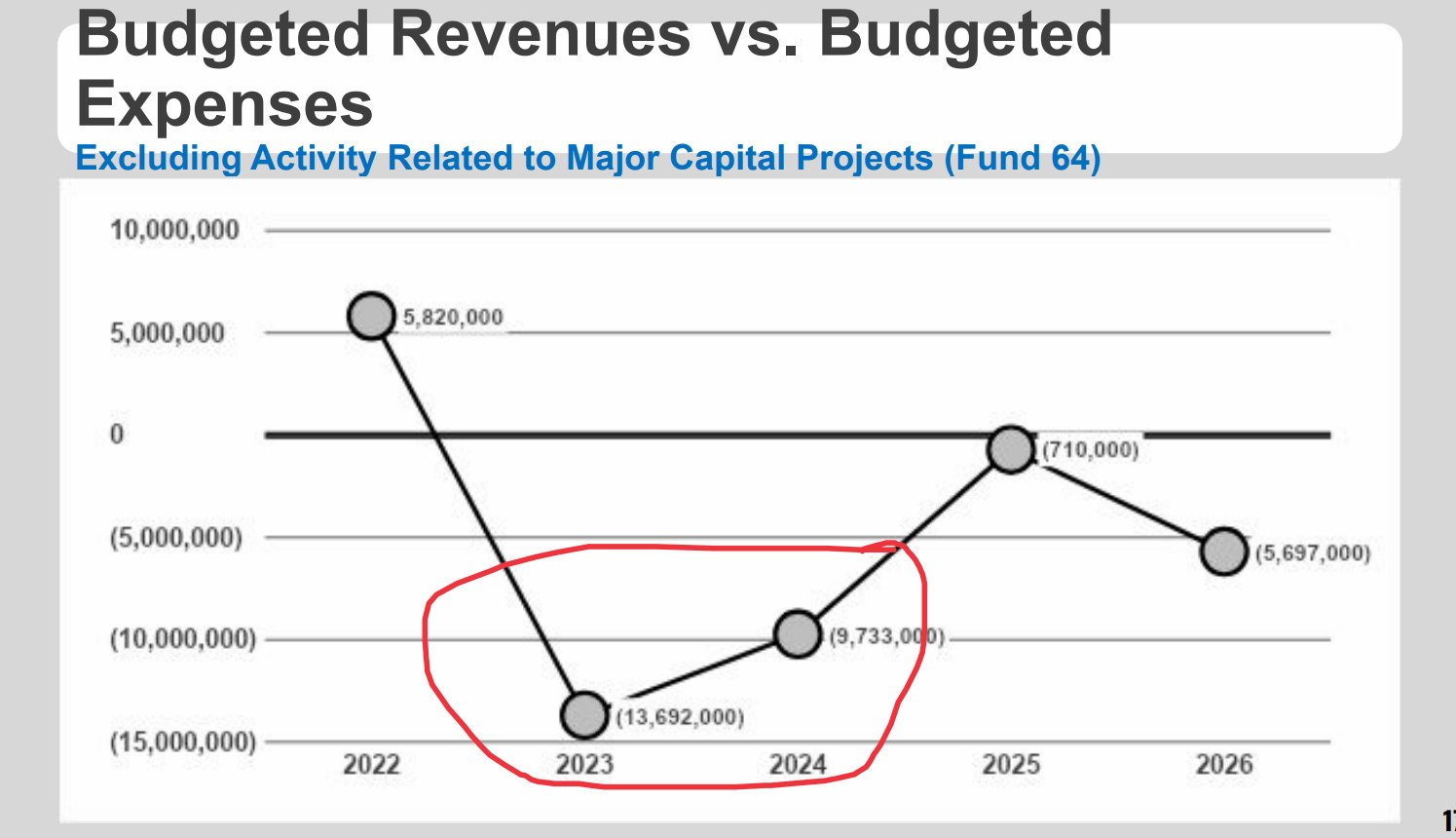
In the case of District 65, you don’t have to look very far (budget presentation) to see how we got here. In FY2023 and FY2024 the District ate nearly $23.4 million in operating losses.2 In both of those years the Boards were promised balanced budgets at the start of the year and ended the year with a surprise! The Board in both years, under Board President Hernandez imposed basically no consequences - they went almost all of FY2024 not even having a CFO or even modest financial controls. 3
Consider the alleged kick-back contracts in the Horton indictment - the District initiated no-bid contracts with the three firms and then according to the indictment, paid whether work was performed or not, no questions asked. The Board knew of these contracts (it was in the monthly list of bills) but didn’t ask a single question in public about them. I wrote a story about the District hiring a felon back in 2023 to do some kind of weekend equity dance program, they paid him out too without him rendering all the services.
There are hundreds of vendors who have been contracted without bidding, going back years. It wasn’t until after FY2024 that they even started having conversations about these problems.
The consequences for this will now be borne by the families and teachers as the District closes buildings. Yet, we still pay almost $14 million (8% of the annual budget) in non-instructional staff per year. We pay almost $4 million a year in compensation for the top admins (people with Director and above titles) alone (raw data).
At the same time, academic achievement lags way behind our neighbors and the achievement gap continues to widen. Consider the ETHS test results posted this week:
In 2025 on the ACT mathematics section, 79.6% of white students scored in the proficient range, compared to just 17% of Black students and 30.5% of Hispanic students.
This is shocking and abysmal. The system is very broken for almost everyone: the students, the taxpayers, and the teachers.
Meanwhile, even the local educational inequality is staggering. This morning, Northwestern reported a shipping tycoon donated an unspecified sum to a new Kellogg building and they’re more than halfway to their $600 million dollar goal.
The most recent, unspecified gift from Drake has brought Northwestern to 52% of a $600 million fundraising goal to pay for a new building at the college, after the school last year launched its Full Circle Campaign to expand the school’s capabilities and construct a new tech-savvy educational hub.
Throw in the $800 million for the Stadium, the $300 million for the new Allen Center and District 65’s financial woes are a rounding error to tax-free Northwestern. Watching big donors prioritize Executive MBA programs while our public schools crumble and close doors is heart breaking. But I’m sure someone will comment, “Who in their right mind would give District 65 money after all this malfeasance?” and they’re not wrong.
Like the NY Mag story points out, we’re not alone in this - Ann Arbor, Montclair, Newton, and Princeton are all college towns outside of big cities with similar problems.
District 65 Vacancy Appointee
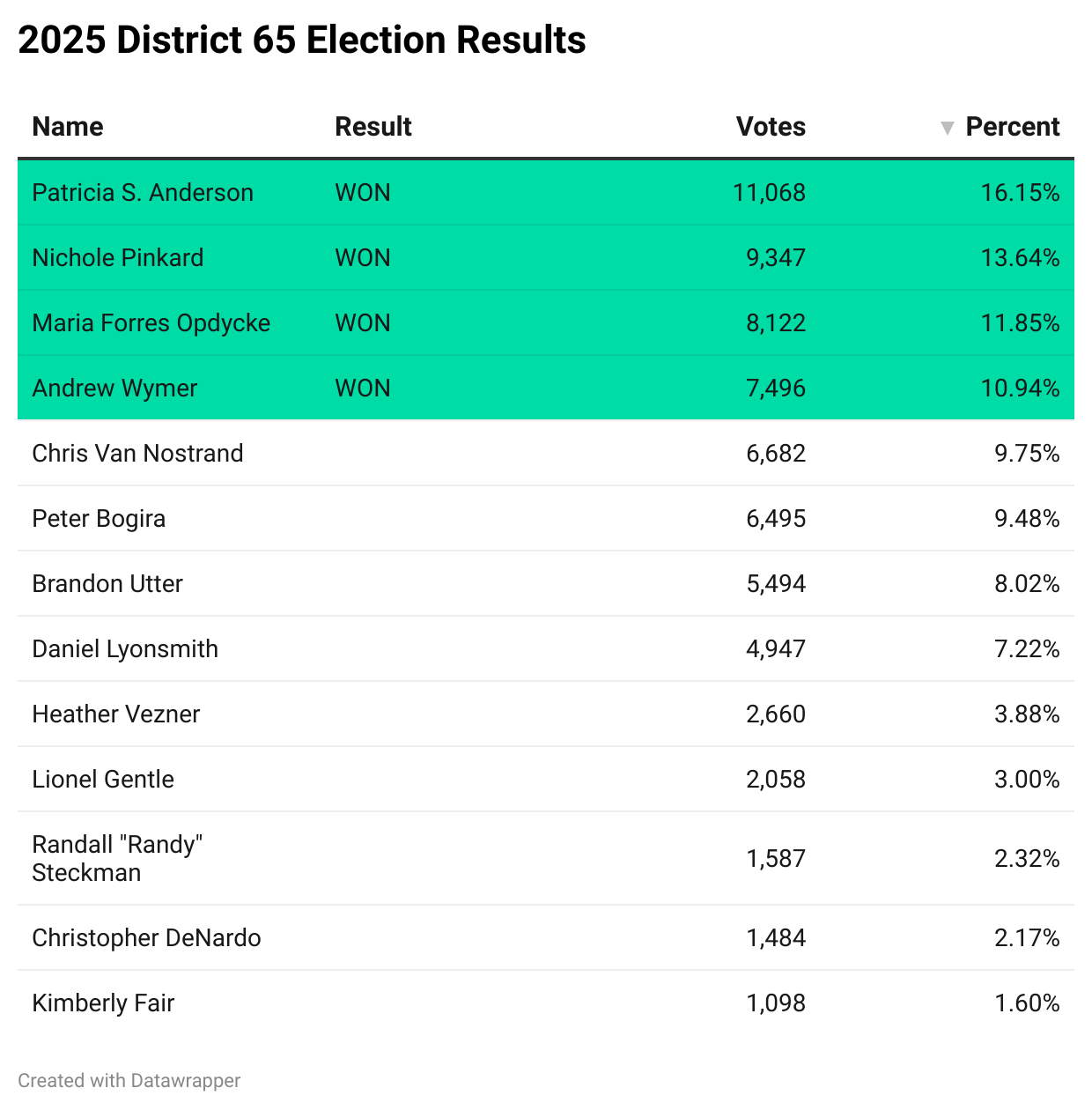
I’ve had a couple people ask me about my opinion on how the Board should appoint the vacancy left behind by Omar Salem’s resignation. I don’t really have a good answer to this, but the results in the last election are below. The most democratic solution is probably just to pick from the top of the list?
The Board has closed session meetings to discuss on Dec. 2 and Dec. 4. You can apply by Wednesday, Nov. 19 at 4:00pm.
Policy 2:110 President
The Board of Education elects a President from its members for a one-year term. Board President elections shall be held at the organizational meeting of the Board and at the meeting on the annual anniversary thereof. The duties of the President are:
…
2. Focus the Board meeting agendas on appropriate content;
9. Prepares agenda in conjunction with Superintendent
At the time, they had nearly $30 million in reserves left over from the 2017 referendum. These losses essentially eliminated that reserve fund, in violation of the resolution passed during the resolution (with no consequences to anyone)
Dr. Horton was Superintendent for most of FY23 (July 2022 - June 2023) but didn’t stick around for the bad news, he left May 30, 2023. Dr. Turner was Interim Superintendent during most of FY23 and then Superintendent FY24 (July 2023 - June 2024). The new CFO, Tamara Mitchell was hired at the start of FY2025 (hired June 10 2024).