Special Ed Transportation Bidder Accuses District 65 Administrators of Foul Play
KalaJu Elite Fleet protests the December award of Transportation Contract, claims it will cost D65 over $3 million dollars
I’m back to doing investigative work again. If you’d like to become a paid member, with unlimited access to the Inspector General tool (you really should try it), click below. If you’d like to make a one-time donation you can do it here. I re-invest every penny (and then some) back into FOIA Gras.
This is a long but wild ride, bear with me here. We have to start with some history.
One of the major cost factors impacting District 65 has been transportation. I’ve written about it. The Roundtable has written about it. The recent West Ed special education audit, published November 2025, documents the trajectory:
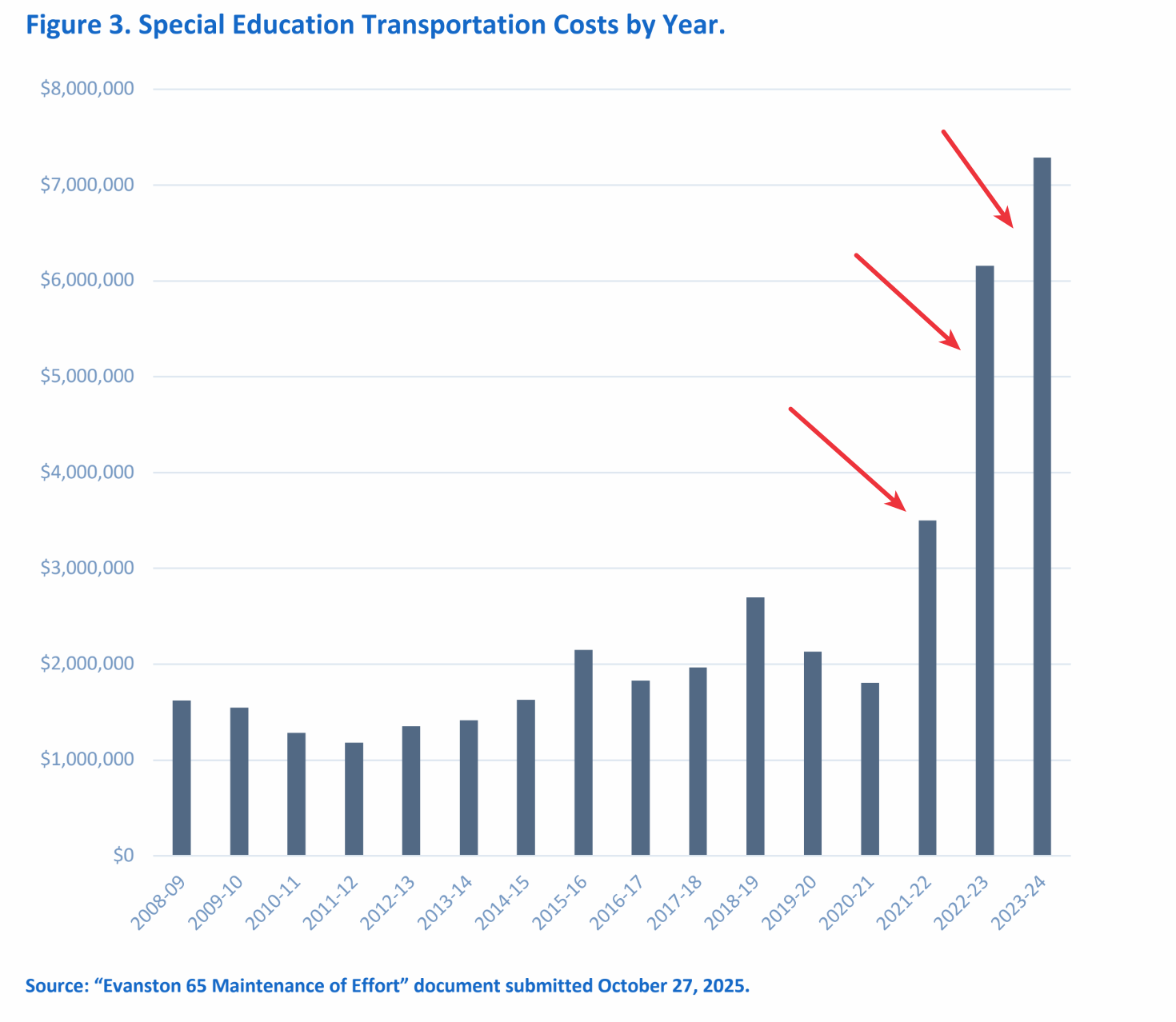
As of now, we still don’t know why. The auditors found no single clear cause for the spike.
This increase is not in alignment with the moderate increase to special education student population data seen in Figure 7, and, while out-of-district placements did increase (see Table 3), the percentage increase is not commensurate with the nearly 3 million dollar increase in transportation spending seen in 2022-23, meaning there is likely not one clearly identifiable cause of the increase, and addressing these costs will need to involve a multi-faceted approach to how special education transportation is decided on and supported by the district.
In August 2022, then-Superintendent Devon Horton signed a no-bid transportation contract with BL Brokers Inc., doing business as BriteLift Inc. The cover memo to the board was three sentences. No competitive bid. No RFP.
That contract expired on July 15, 2025 but BriteLift operated this fall without a contract from the Board. On December 8th, the Board unanimously passed a retroactive extension covering July 15 through January 31, 2026. The December 8 CFO memo listed only two prior board actions on the BriteLift contract — the 2022 approval and a 2024 insurance reduction.
By FY2025, actual spending came down to $3.22 million, an improvement driven by route optimization and more insurance cuts. The forensic audit underway covers district spending from 2020 to 2024, with specific focus on transportation. The no-bid BriteLift contract falls entirely inside that window.
The Special Education Transportation RFP
To get pricing under control and comply with the law, the district issued a Request for Bid for Taxi Services on November 21, 2025. Bids were due a few weeks later on December 8 at 11:00 a.m. — the same day the board was asked to retroactively authorize five months of lapsed payments to BriteLift.
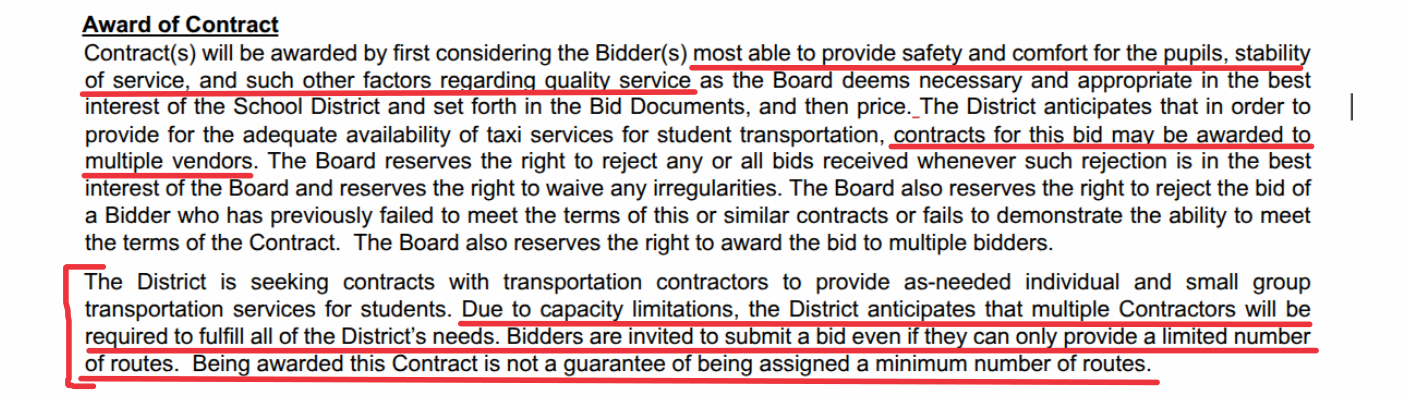
The bid contemplated a 3-year contract beginning February 1, 2026, with a potential seven-year extension. It covered as-needed individual and small-group transportation for students. The RFP explicitly anticipated awarding to multiple vendors:
The District anticipates that in order to provide for the adequate availability of taxi services for student transportation, contracts for this bid may be awarded to multiple vendors. Bidders are invited to submit a bid even if they can only provide a limited number of routes. Being awarded this Contract is not a guarantee of being assigned a minimum number of routes.
Questions from bidders were due December 3. One of the questions discussed in the board meeting concerned awarding the contract to multiple vendors (remember this).
Opdycke (Board Member): But we could potentially have multiple vendors that could service this if we found a reason that was compelling?
Mitchell (CFO): Correct.
The Rubric & Bid Approval Process
The bid evaluation is confusing because it’s not really apples-to-apples. You can view the bid evaluation rubric. It’s hard to read and I created a corrected bid tabulation — a line-by-line breakdown of all seven bids.
Vendor | $ Routes | Est. Annual Cost |
|---|---|---|
Compass | 1 | $337,744* |
Kalaju Elite Fleet | 55 | $1,035,232 |
EverDriver | 55 | $2,016,256 |
BriteLift | 55 | $2,040,896 |
Collaborative | 55 | $2,466,112 |
Yellow Bus | 55 | $2,993,056 |
All–First Student | 55 | $3,716,416 |
The contract was awarded to BriteLift in a 6-1 vote (Maria Opdycke voted no) in the 12/15 meeting. But as you can see, BriteLift wasn’t the lowest bidder. There was another bidder, KalaJu Elite Fleet, that came in much lower by almost a million dollars, but the District didn’t cost out the full 55 routes, only 30.
It’s not clear why they did this — I obtained via FOIA copies of their bids and you can view the raw documents. There’s no indication in the KalaJu bid that they could only service 30 routes.
Since they didn’t price out all the rides, it’s hard to tell what the true cost savings would be. Comparing the two, KalaJu’s bid is cheaper in almost every vector and significantly so, in some cases.
Pricing Component | BriteLift | Kalaju |
|---|---|---|
Base fee (per trip) | $46.00 | $32.00 |
Per mile — standard vehicle | $3.00 | $2.50 |
Per mile — wheelchair-accessible | $3.00 | $4.00 |
Aide fee (≤60 min) | $60.00 | $22.50 |
Aide fee (61–90 min) | $72.50 | $37.50 |
Aide fee (91–120 min) | $85.00 | $52.50 |
Harness (per trip) | $25.00 | $5.00 |
In the 12/15 board meeting while the Board was evaluating vendors, the million dollar delta in pricing came up:
Opdycke (Board Member): The million dollar delta is a number I would better like to understand. It is my impression after talking to Tamara that part of the reason why BriteLift is recommended is because of the timeline and the surety of their availability to provide services?
Mitchell (CFO): So to be clear about the dollar amount, the amount that is listed on the bid tabulation form for the first responder [Kalaju] is based on the number of vehicles they currently have in their fleet, not the number of vehicles needed to service our contract. When compared to BriteLift that’s a big part of why that difference is so much. We could only calculate the cost based on the vehicles they have in their fleet right now versus the vehicles the could get in their fleet. Additionally, when I engaged with the company and asked additional questions to due my due diligence, I learned they did not have the full staff needed right now to be able to service our contract. so keeping those things in mind with “are they fully staffed right now?” with it being December 15th would they be able to do all those things to get the staff hired as well as secure the vehicles?
KalaJu disputes this characterization. You can read KalaJu’s bid - there’s nothing that indicates their fleet is incomplete and the executive summary suggests they had the capacity.
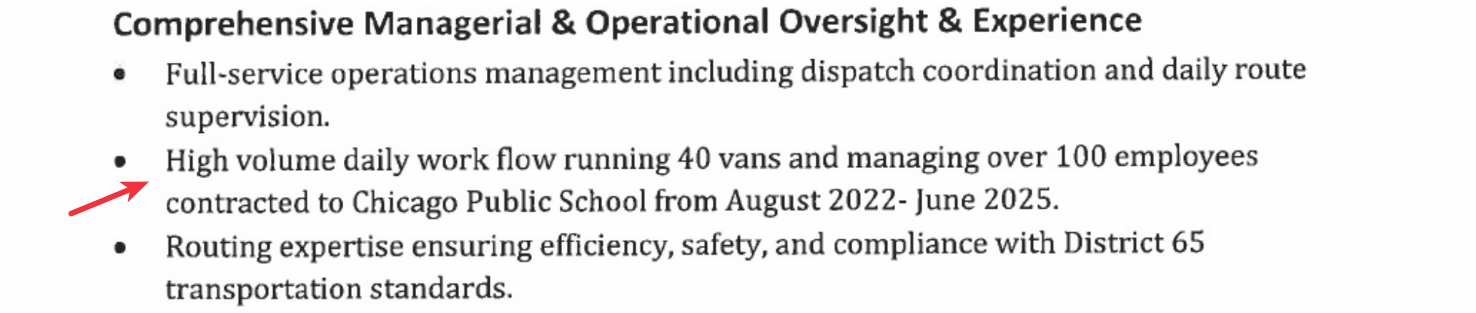
But even if KalaJu couldn’t handle the capacity, the RFP itself suggests that they were encouraging vendors to submit “even if they can only provide a limited number of routes.” It seems improper to suggest that vendors submit even limited route profiles, and then at the time of bid evaluation, punish them for that. KalaJu wasn’t the only one, Compass’ bid was also essentially thrown out for not covering 100% of the routes.
The second thing that came up was KalaJu’s work with the Chicago Public Schools. This is at 3:30 in the 12/15 meeting:
Wymer (Board Member): So, we're talking about a provider that this level contract would be far above anything that they've done. Is that right?
Mitchell (CFO): For the first one [KalaJu]. Correct.
Opdycke (Board Member): Did they say they don’t do this?
Mitchell: In their bid documents they shared some level of service that has been provided to other schools.
Wymer: At this level though, if they don’t have the vehicles, I'm trying to understand: not having the vehicles, not having the staffing?
Mitchell: Correct. They have provided some service to Chicago Public Schools. I believe their contract with CPS ended summer of 2025. I believe. I cannot recall off the top of my head. I cannot recall how many vehicles were involved in that contract. They currently have some smaller contracts with private schools right now, but not a single contract right now that has 55 vehicles available.
KalaJu again disputes this characterization, and the stats with CPS are right in their bid document’s executive summary above.
There is additional public evidence to support KalaJu’s claims. In 2023, CPS authorized $5 million dollars a year with KalaJu, who is currently in litigation with CPS over a billing dispute. Their lawsuit indicates that CPS was spending more than $500k a month and KalaJu is now idling.
But even if all of this was true, the RFP itself says the District was looking to hire multiple vendors. Not only was KalaJu unfairly left out, all the bidders (and the taxpayers) were when the rules seemingly changed on 12/15/2025.
The Protest
In mid-February, KalaJu sent a protest letter to the Board you can read here. It comes on pretty hot, accusing the District of arbitrarily neglecting their bid, which could’ve saved the District $3 million dollars.
This letter serves as a formal Bid Protest of the District's unfair, arbitrary, and non-compliant action in awarding a transportation agreement to a single vendor. As you know, the incumbent vendor, BL Brokers Inc., DBA BriteLift inc., submitted a bid that was ~$3,000,000 greater than our bid (over three years).
The letter goes on to accuse the District of developing a process that specifically favored the incumbent, BriteLift.
It is apparent that the District developed a process that, by design or default, defaulted exclusively to the incumbent, solely because the incumbent was already in place. Under the circumstances, the outcome of the process was pre-ordained – in an apparent attempt to sanitize the no-bid process that put the incumbent into that position in the first place.
There’s no legal structure in Illinois law for a “protest letter” as far as I know, but he’s got a pretty good point. You really should read the protest letter.
Board President Responds to KalaJu
On March 4, the Board President responded to KalaJu’s protest. (3/7 Update: I’ve temporarily removed the full email until I can confirm authenticity but I have left snippets in below)
As I emphasized in my prior communication to you, and I would assume you are aware as a transportation vendor, school boards are not required to award transportation contracts to the lowest priced bidder. Instead, the Illinois School Code provides and prioritizes the following: “[transportation contracts are to be] awarded by first considering the bidder or bidders most able to provide safety and comfort for the pupils, stability of service, and any other factors set forth in the request for proposal regarding quality of service, and then price.” 105 ILCS 5/20.21(a)(xvi).
Anderson is right that state law permits the Board to consider other factors besides price in the evaluation of transportation contracts:
(xvi) contracts providing for the transportation of pupils, which contracts must be advertised in the same manner as competitive bids and awarded by first considering the bidder or bidders most able to provide safety and comfort for the pupils, stability of service, and any other factors set forth in the request for proposal regarding quality of service, and then price; and
And this language is captured in the RFP:
Contract(s) will be awarded by first considering the Bidder(s) most able to provide safety and comfort for the pupils, stability of service, and such other factors regarding quality service as the Board deems necessary and appropriate in the best interest of the School District and set forth in the Bid Documents, and then price.
But the Board didn’t use a rubric that scored safety, comfort, or quality of service — they evaluated this RFP solely on the ability to service 100% of the routes immediately. You can watch the 12/15 meeting or view the rubric yourself. Only a single vendor could meet that criteria - BriteLift.
In Anderson’s response to KalaJu, she suggests his bid didn’t meet the criteria of the RFP.
Simply, your company did not meet the District’s needs here. Based on your own bid and later responses to the District, several vehicles necessary to meet the District’s needs were subject to a possible lease that was not finalized and it was not clear that you had sufficient employees to dedicate to the contract.
But again, there’s no evidence to suggest this is true. If you take KalaJu’s bid at face value, they had the vehicles and staff to support the work. Even if they didn’t, the RFP didn’t require them to! The District essentially punished this vendor for meeting the terms of the RFP.
As a practical matter, I get it: one of the reasons that BriteLift was so expensive was because they operated under a non-competitive bidding environment for years. Changing special education bussing mid-year is difficult and the special education parents I’ve spoken with like BriteLift’s service.
This presented an opportunity to save potentially millions without any documented decline in service (many of these vendors lease vehicles from the same place!). There’s obviously companies that service this market: the RFP was open for 2 weeks and they got 7 competitive bids! Yet we picked the one vendor that temporarily exploded District costs (2021-2024) and we still don’t know why? 🤔
The RFP itself even envisioned the possibility to make this a multi-award situation, evaluate the performance and reward the lowest cost/best price vendor. It’s almost the whole thing!
For a District that just spent a year doing SDRP, talking about “systems and structures” and scoring rubrics for closures, we kind of just YOLO’ed this bid. Let me know what you think in the comments.