District 65's Financial Problems are the Result of Mismanagement
A walk down memory lane...
Over the last few months I’ve spoken to an increasingly large number of people that argue, “District 65’s problems are structural. While the prior Board and Dr. Horton had some bad ideas, those are not the reason we are in this position. Take it easy on them!”
Let’s go for a ride.
The View from 2018
In the mid-2010s the Board was aware of the financial issues facing the District. In 2017, the voters passed a referendum 80-20. You can read the text of the resolution passed in April 2017. The intent to provide additional funding thru 2025 and provide funds for capital improvements.
Even after the referendum passed, the Board was still looking at future budget deficits as soon as 2021. This 2018 budget document is very fascinating because not only did they acknowledge the upcoming deficits, they also recognized that the referendum balance would get built up and then spent away by 2025.
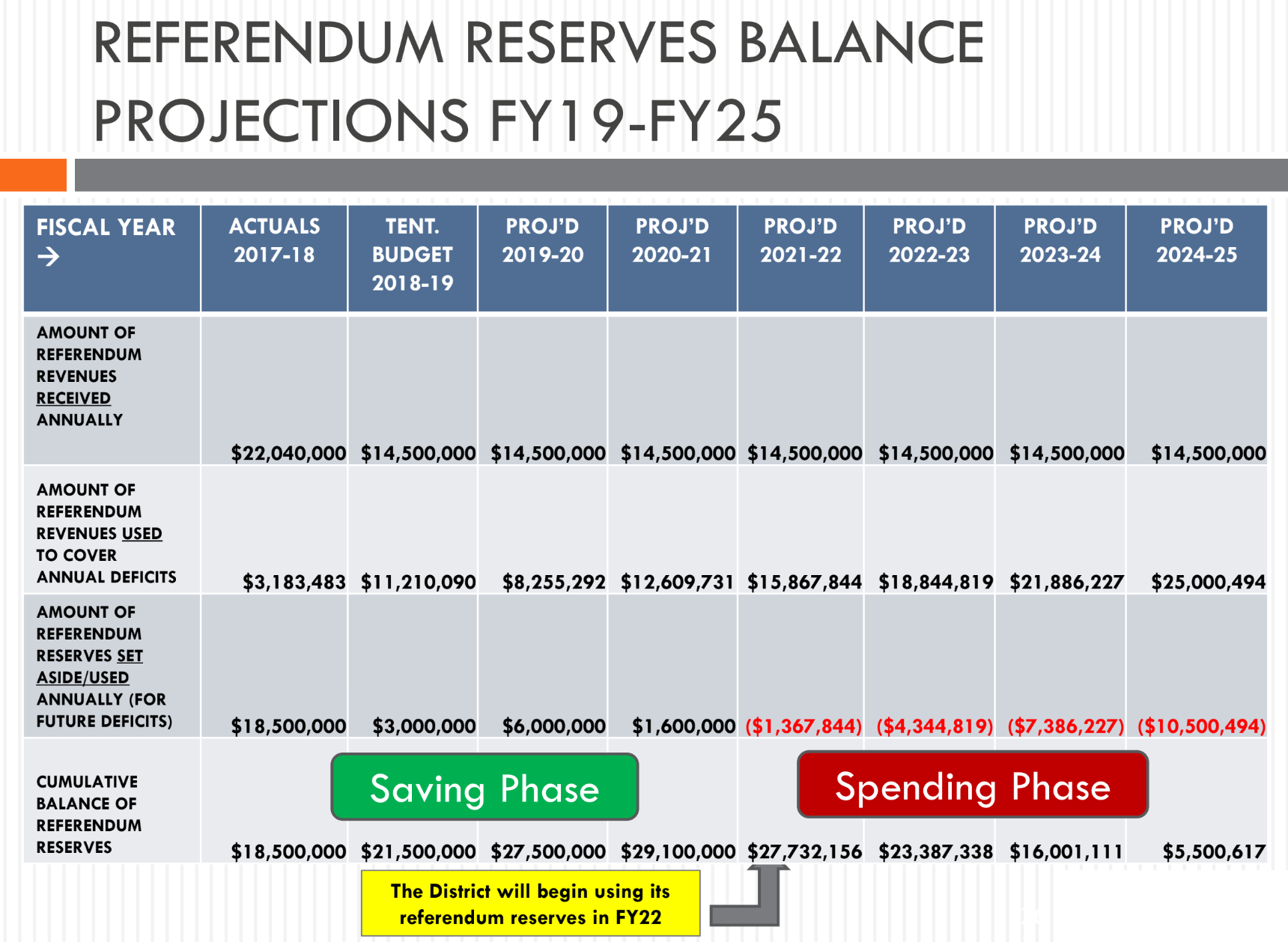
This is almost exactly what came true.
Recognizing the risk, the 2018 board was presented with a plan to avoid this situation and maintain the referendum balances.
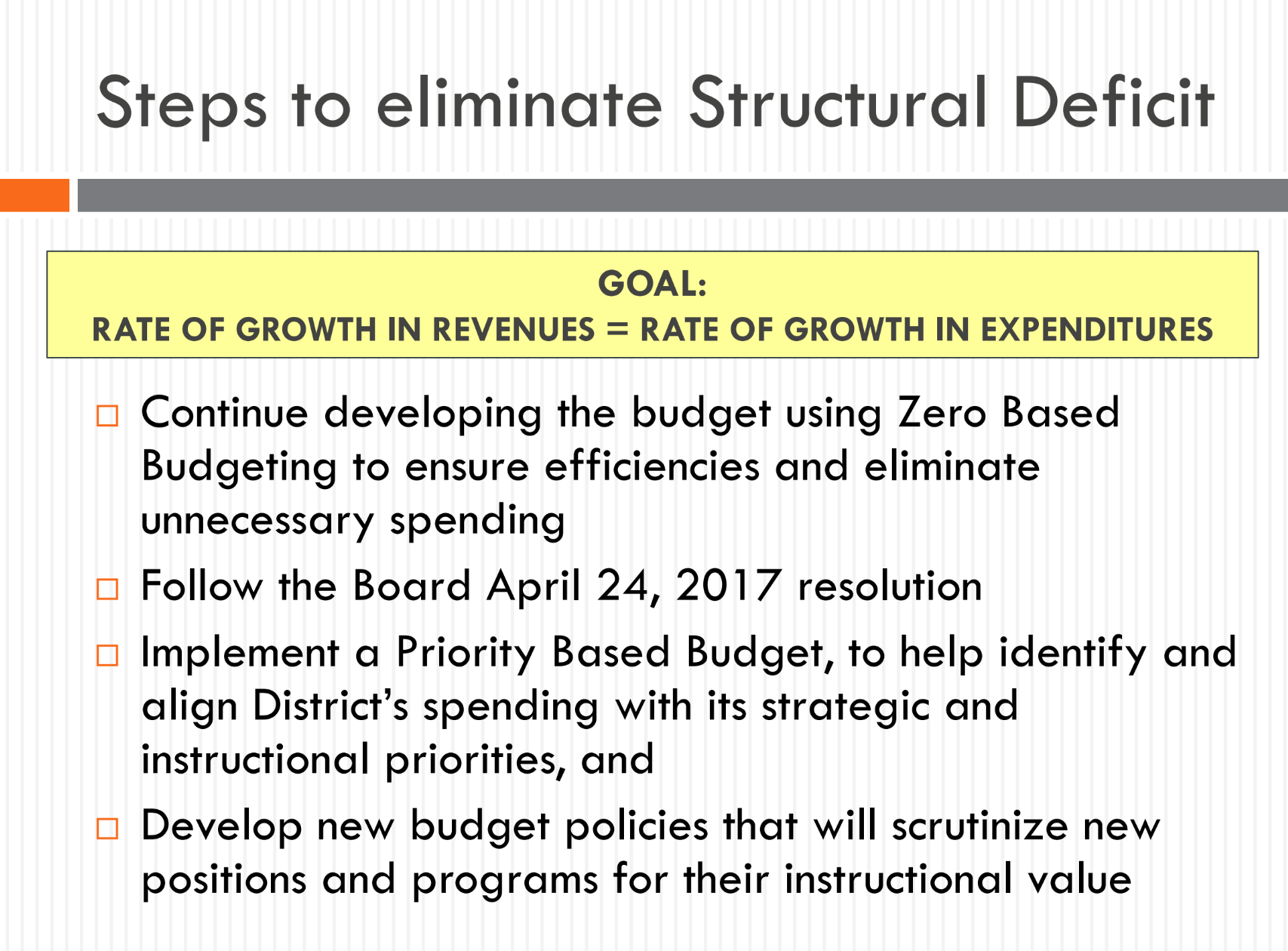
During this time, the board was working to implement Zero Based Budgeting (ZBB) — a budgeting method where every expenditure must be justified from scratch each year, starting from a "zero base" — as if the budget were being built for the first time. The document states: "For the FY16 budget, budget requests from administrative staff were prepared using the zero-based budgeting process. All expenditures were examined for their purpose, relation to the Strategic Plan and possible efficiencies."
So in the initial ZBB roll-out administrators prepared the requests — program managers and administrative staff built the budgets using ZBB. The scope was "all expenditures" — which would include administrative department operating costs alongside program costs.
This was a hot topic at Board Meetings in the 2010s, discussed in over 30 meetings but here’s a few highlights:
March 2, 2015: Introduction of ZBB to District 65 Budgeting
Nov 7, 2016: ZBB Claims $220k in Savings FY2017 Budget
June 4, 2018: “Fourth year in a row of using ZBB” for Budgeting
By 2020, it was mostly theater. The District quietly changed the policy to “non-personnel expenditures” — administrative headcount was now exempted from ZBB. In May 2021, the business manager issued a memo falsely claiming they were on their 20th year of ZBB.
Consider the findings from Dr. Grossi and CFO Tamara Mitchell in July, August and September 2024. Dr. Grossi wrote;
It appears that more effort was placed on presenting a balanced budget than actually balancing the budget. I don’t believe the primary issue over the past two years was that the District spent over budget; I believe the issue was that the superintendent and the board was presented with a bad budget.
They further revealed the District lacked even basic financial controls:
Financial statements were often delivered late to the Board or not at all. The Board never even saw 2 month in 2020. Sometime around 2019-2020, there was a change, such that, bills were paid before the Board approved them.
There was no state-required approval process for contracts over $25,000. I complained a lot about this.
Employees weren’t aware of their budgets and controls on overspending were only added in September 2024.
The purchasing card was essentially unsupervised - Dr. Horton used it to buy gift cards, move to Atlanta, illegally donate to a PAC, among other things.
Multiple pay-runs were being done each month, “circumventing the purchase order and approval process” letting the Superintendent (according to the indictment) approve payments outside a review cycle.
Administrative headcount was essentially un-monitored and they needed a system to “manage staffing levels and more importantly staffing needs based on student enrollment levels and educational objectives” (September 2024)
If anyone says, “nobody saw this coming” - that is absolutely false - this has been a slow moving train coming at us for decades. The Boards in the 2010s were trying to get ahead of the crisis by raising money via referendum and putting budgeting practices in place. In 2018, it looked like there might be a path forward!
But by the 2019-2023 era, all of that was thrown out.
2019-2024 Drunken Sailor Era
From 2019-2024 District 65 burned through tens millions of dollars of completely unbudgeted funds.
A Naperville resident (another District having problems) recently put together this cool site: District Vitals. The chart that stands out is the “Contracted Services by Function” — i.e. purchased services: consultants, busing, food providers, etc:
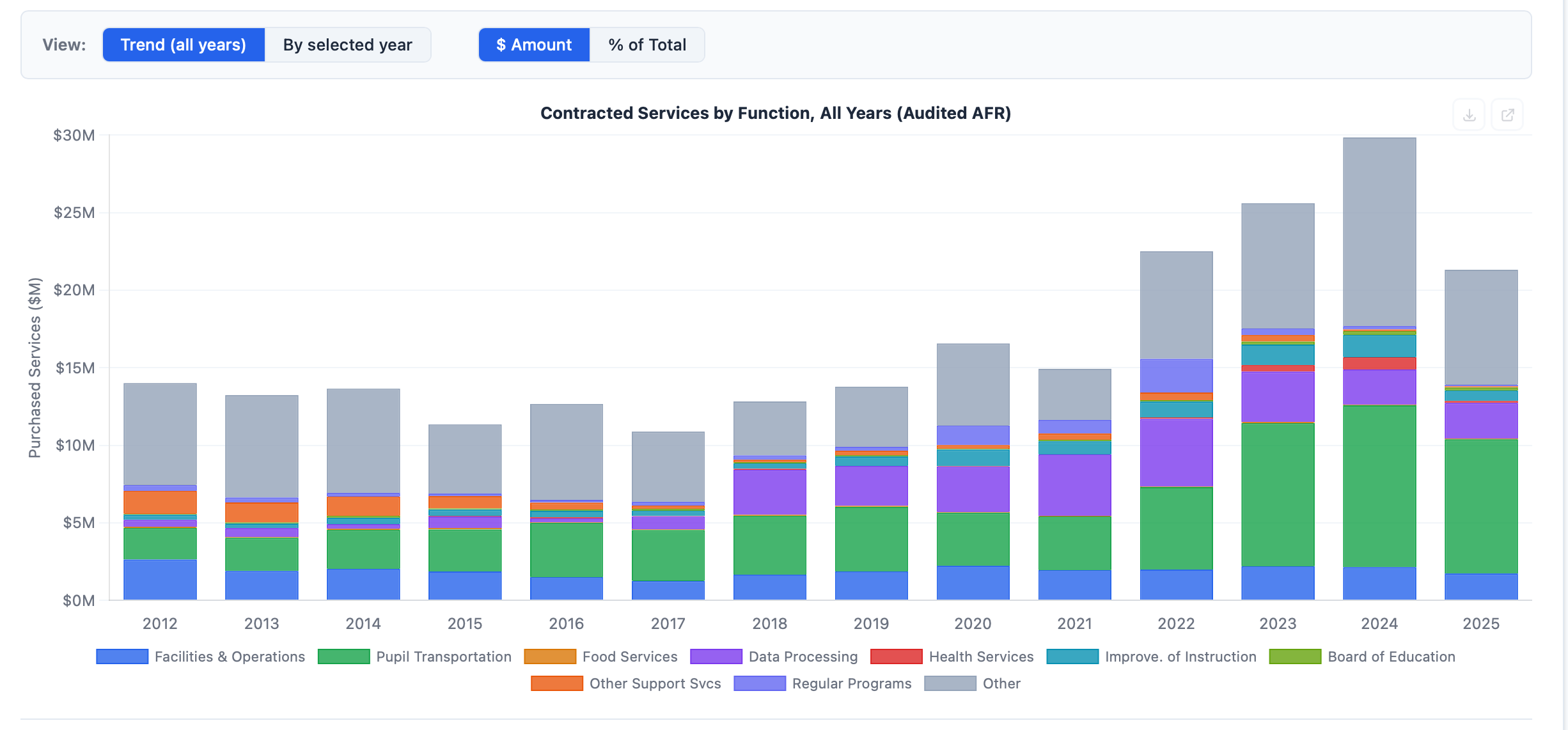
Purchased services almost doubled during this period compared to the 2010s. We spent money on all sorts of things, many of which were not Board approved or only loosely presented:
A $4-5M+ increase in busing costs that we still don’t understand on contracts that were not competitively bid, including paying Positive Connections $2.8 million for SY2021 (July 2020 to June 2021) when the students were 100% remote - more than they had paid the year prior when students were in buildings.
The District increased spend on outsourced agencies for placement going $2.8 million dollars over budget in a program managed by Dr. Turner’s sister.
They spent $2.5M on CREATE65/PREP65 - teacher and principal residency programs that are now shuttered, had a less than 50% teacher placement rate, and made life very difficult for their residents.
The District spent $500k on six months of 24 hour security for Dr. Horton. After the Board took that away, the District build those functions in-house by hiring a CPS Police Chief.
$283k in alleged no-work contracts to the three vendors in the Horton Indictment.
In 2024, the District spent over $130k in food, including frequently catered lunches for Dr. Horton and his staff.
More than $100k in Capital funds were spent on fancy police cars with tinted windows that were involved in an accident and the District didn’t file an insurance claim (we paid out of pocket for no reason!).
They hired a felon for $35k and skipped his background check to run a weird dance program for at-risk youth and then paid him out before he filled the terms of his contract.
When Dr. Horton owed $10,000 to $14,000 in late fees for separation penalties, Board President Sergio Hernandez let him off the hook.
And there is a long tail of small things like the shipping containers that sat on school property far longer than they should have, technology expenses, or Dr. Horton using the P-card for dinners.
On the headcount side, Larry Gavin at the Roundtable wrote in 2025 and 2026 about the increase in administrative staffing as enrollment dropped. I can give concrete examples:
In 2020, Dr. Horton created a position that didn’t exist in 2019 - Deputy Superintendent (2020 org chart). In 2023, that position paid $213,196/year in total comp.
In 2021, he created another position that didn’t exist and is now eliminated - Special Assistant to the Cabinet, later rebranded as Chief of Staff. That role paid $153,843/year in total comp.
These are just the roles that show up in the org charts. The unmonitored creation of six figure jobs was a major issue - you can view my year-over-year compensation datasets (see tabs in spreadsheet for years). Most of these new roles were never presented to the Board for approval or even awareness. As Grossi revealed in 2023, there were no controls on hiring at all.
And then there is the Foster School. Currently, District spends $3.25M per year for the building lease, directly out of operating educational funds. This is the result of the Board using a lease certificate to fund construction instead of holding a referendum. Referendums are the typical mechanism for school construction, are incredibly common, and don’t bog down the operating budgets. But even back in 2022, before they took out the lease certificate, it wasn’t enough money.
An April 2022 budget of $55,892,034 for a 108,649 square foot building or an alternative design and cost of $46,522,603 for a 103,395 square foot building.
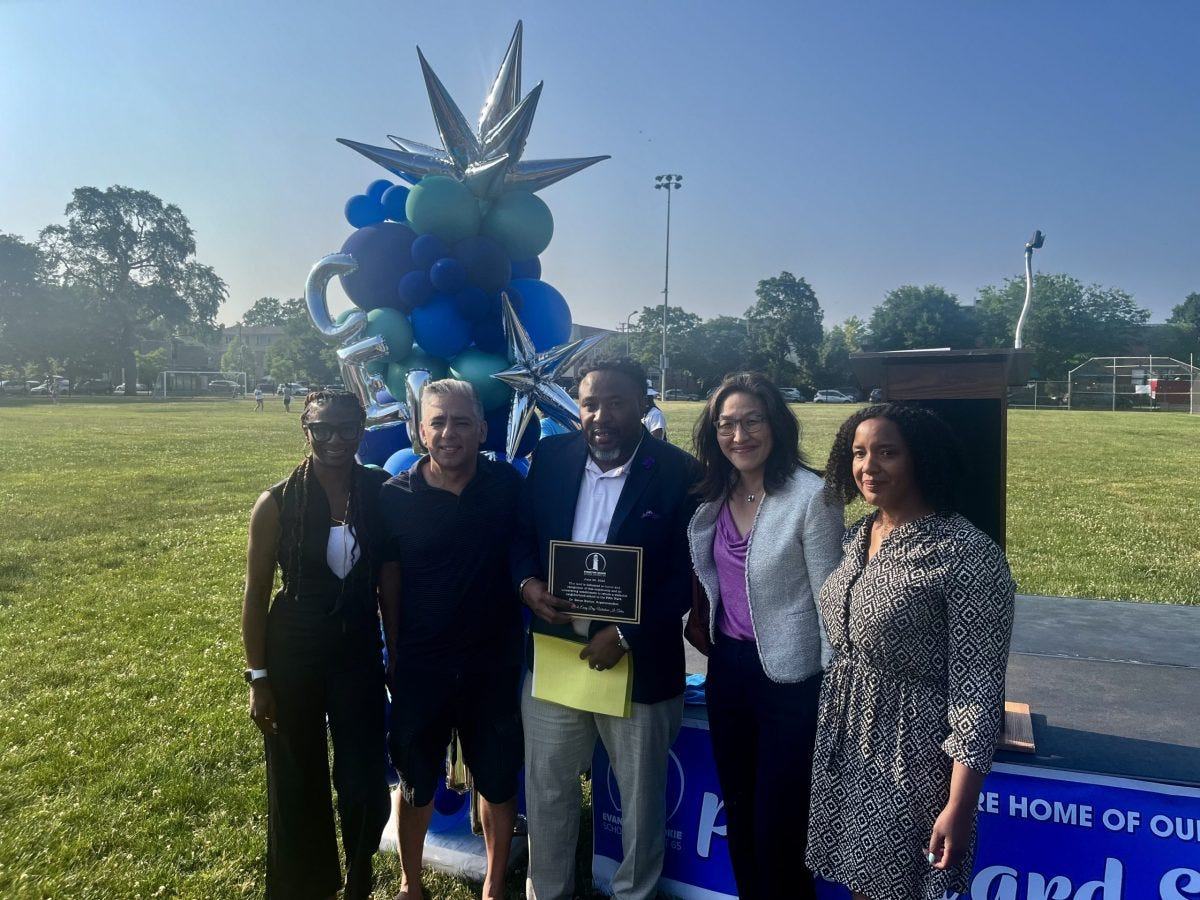
The lease certificate was finalized a month later for only $40 million dollars — not enough money. There was no discussion on this issue by the Board for 18 months until October 2023, after my story, the Curious Case of the Missing School. During this time, neither Dr. Horton, nor any administrator, nor even the architects Cordogan-Clark, presented this issue to the Board. But also, the Board never asked. They rewarded Dr. Horton by giving him an award in an empty field.
Total Damage: ~$20 Million Dollars
It’s hard to get an exact figure for the losses but the most obvious source of data is the surprise budgetary misses that happened in 2023 and 2024. In both of those years: they started the year with a balanced budget and ended the year with multi million dollar losses.
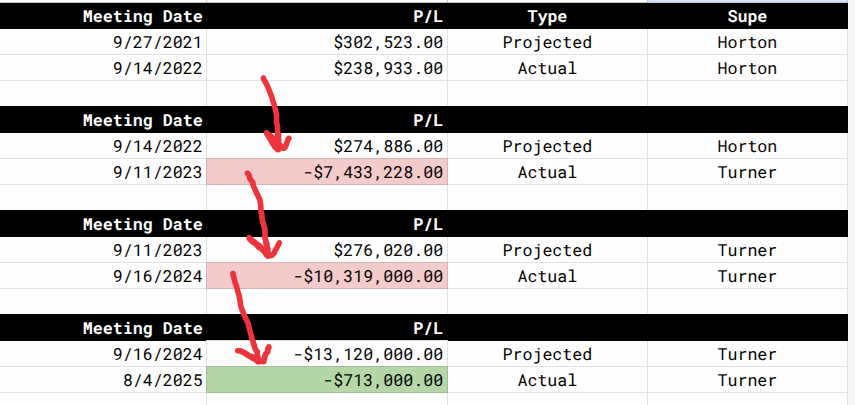
Imagine: you’re on the Board - you start the year thinking there is a balanced budet ($274,866 surplus) but end the year losing $7M dollars and nobody warns you. Then, the administrators tell you the budget is balanced and it happens AGAIN the following year. The prior CFO, Obafemi left town a month before the first bad budget reveal and the Board took almost a full year to backfill the role, during which, millions of dollars of unbudgeted funds were being spent.
You can still say, “Tom, this is all bad but even if they had ZBB and financial controls in place, we’d still be in this problem. It’s structural.” Sure, $20 million dollars is not the $200 million needed in deferred maintenance. But with money in the bank you wouldn’t need to have discussions about firing librarians or counselors in order to purchase a roof for King Arts. Discussions about facilities planning could operate from a place of strength — we could be smart about building closures instead of the current “Hunger Games” situation.
I think there are genuine structural challanges with District 65 (or almost all K-8 districts in IL) and I’ve argued in the past that it’s a good reason to consider consolidation with ETHS. However, back in the 2010s there was meangingful progress to address these issues from the Board — all of which were undone and mismanaged by the Administration and Boards during the post-2019 era.