Guest Post: District 65 Has a Money Illusion
The StudioGC Report deserves a second glance
From time to time, I post guest essays on this blog from people who may not necessarily have their own platform (March 2026, June 2026). This one is authored by Sam Lang. Sam has been an Evanston resident for over a decade and has two children in District 65, one at Dewey Elementary. He can be reached at samlang@gmail.com.
I generally agree with his findings. The capital plan requires more scrutiny - the Roundtable published a story yesterday about a similar topic. Yesterday was the first time I’d seen the full StudioGC report, something I wrote about back in March 2026. I think I missed it because the report was stored on the District’s website and not the Board documents.
The plan makes a lot of decisions that are the Board’s to make - timing of renovations, selections involving geothermal HVAC systems, bathroom renovations, and so on. Some of these decisions are quite expensive and involve cost-benefit tradeoffs with investments in students and academic performance.
I’m going to be offline for the next few days due to the day job so please act respectfully in the comments!
The District 65 administration has proposed to the Board that Lincolnwood and Dewey be closed to help balance the District's budget. The administration has said it will ground every decision in "clear data" and open communication [1, slide 6]. However, a review of its presentation to the Board raises concerns about transparency and the clarity of the data used to justify its recommendations. In its slide deck presented to the Board on October 13, 2026, the administration estimates "future maintenance savings" of $58 million over 20 years [1, slide 35], which appear to be capital expenditure savings. This number appears to be 20 times the annual operating savings ($2.9M) from closing both schools, but that figure includes staffing cuts, which would not appear to fall entirely under the umbrella of "maintenance." The presentation to the Board also makes clear that the purported $58M savings is in addition to the savings from staffing cuts and operations [2][3]. So the purported $58M savings over 20 years appears to refer exclusively to savings related to capital expenditures. The Board deserves accurate information and clear data when making such a consequential decision, and close review suggests that this number is misleading.
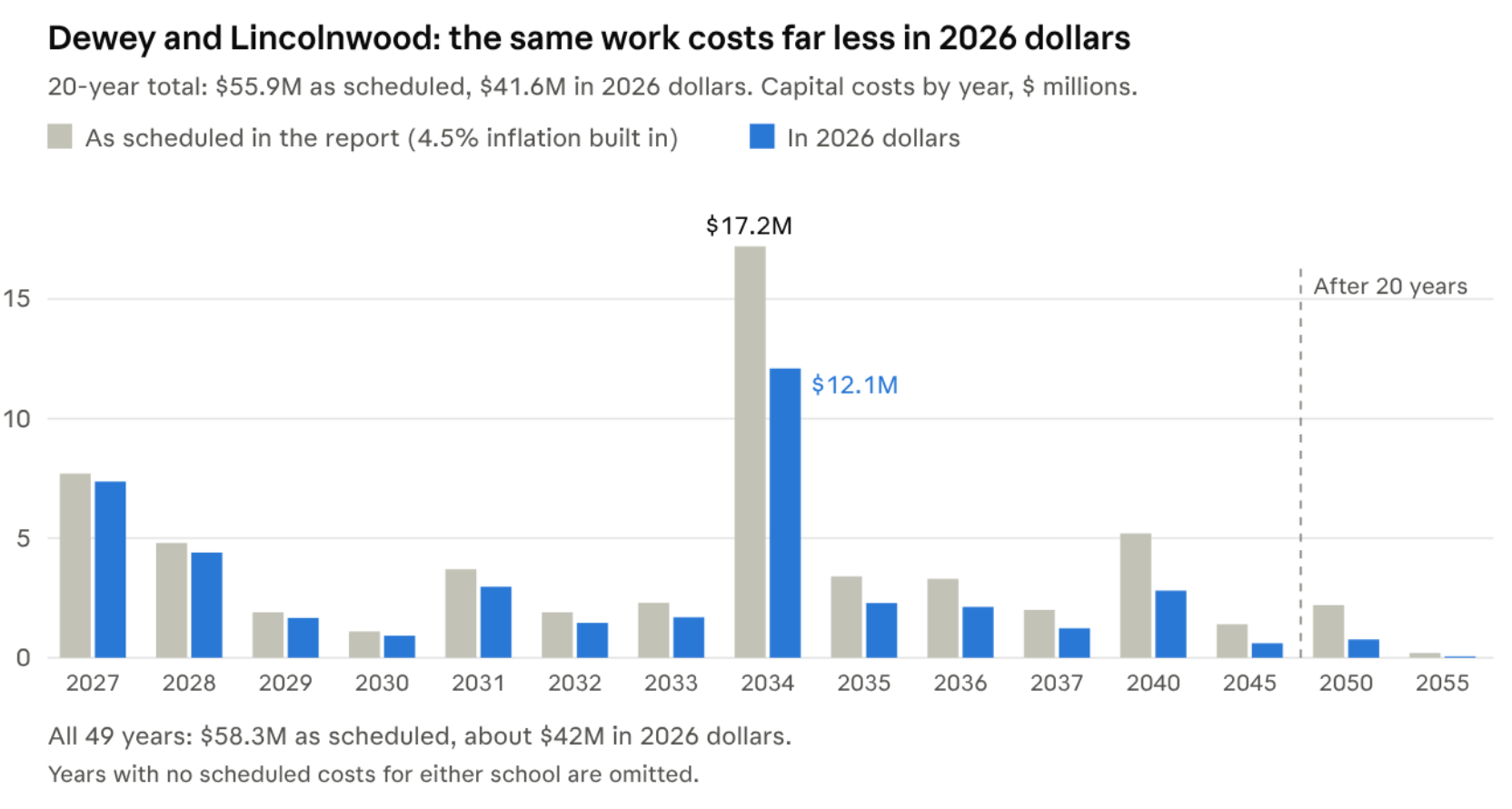
The $58 million appears to have been taken from a report prepared by the architecture firm StudioGC [4][5]. The report states that the needed capital expenditures are $26.7M for Dewey and $31.6M for Lincolnwood (page 22), totaling $58.3M. This is the "$58 million" the presentation refers to. In fact, the report's totals cover 49 years, not 20. Adding only the first 20 years of expenditures for Dewey and Lincolnwood gives $55.9M. Most of the report's expenditures fall in the first 20 years, however, which is why the difference is minor.
The money illusion
The first issue with using the $58M number as a headline for capital expenditure savings is that the savings are stated in nominal dollars, not constant (inflation-adjusted) dollars. The report escalates capital expenditures at 4.5% a year for the next 49 years, and the $58M "savings" has that escalation built in over 20 years. In plain terms, the slide treats a cost avoided in 2046 as equal to the same number of dollars saved today. This is known as the money illusion: people instinctively read dollar amounts at face value but do not adjust for the effects of inflation. Federal budget guidance (OMB Circular A-94) [8] calls for present value in long-term comparisons like this one for this very reason. What would the $58M number be with inflation removed? $41.6M in 2026 dollars. The following chart breaks this down by year:
The illusion of 100% savings on retained properties
The $58M ($41.6M in 2026 dollars) purports to represent savings from capital expenditures that would not have to be spent on these buildings over the next 20 years. However, counting all of it as savings would require that the buildings be sold immediately. On slide 17 of the proposal, the administration clearly states that it does not plan to sell either Dewey or Lincolnwood: "Retain as D65 property; will not be sold, leased, or repurposed in the short term." Slide 19 gives further indication of their intended uses: Dewey is a "solid physical plant that could be used as a swing school," and Lincolnwood is an "ideal site for a potential renovate or rebuild of a modernized facility."
This means that needed capital expenditures will still take place over this period to maintain the buildings. For example, boilers must still be repaired and aging roofs replaced. StudioGC's item-level cost data [9] shows how much: about $14M of the $41.6M is needed work on the buildings themselves, which a retained building still requires. That leaves at most $28M that could be avoided without selling the buildings.
But the administration has said Dewey could be used as a "swing school," with students moving to Dewey for a year or more while a new school is built at Washington. This would require the district to keep capital expenditures closer to the original estimates, reducing the savings to zero for that school until all new schools are in use.
The illusion of savings on improvements
What is in that remaining $28M? The published report doesn't include itemized costs or separate needed repairs from everything else, but StudioGC's item-level cost data [9] does. The $14M of needed work covers roofs, windows and exterior walls, plumbing and electrical systems, paving and drainage, asbestos abatement, and the life-safety items rated urgent or required. The remaining $28M is everything else: new geothermal heating and cooling systems ($8.7M; Dewey's is described on page 77 of the report and Lincolnwood's on page 199), life-safety items rated only as recommended ($10.0M), interior finishes and furniture such as doors, ceilings, flooring and casework ($8.0M), and other improvements and playground equipment ($1.1M). Because the administration has pulled the $58M directly from the StudioGC report and treated estimated capital expenditures as savings, the "savings" include all of this work.
Overall, the needed work continues for as long as the district keeps the buildings, and everything else was never budgeted. That leaves essentially zero real capital expenditure savings from closing Dewey and Lincolnwood without selling them.
Money illusion in the StudioGC report
While the StudioGC report [4] has only been used in the presentation to suggest $58M in savings from closing two schools, the report's roughly $600M headline number for total capital expenditures has been used repeatedly in talking points by District administrators and outside consultants [6][7] to suggest that District 65 buildings are in dire condition and to further advocate for closing schools. So it is worthwhile for the Board to consider scrutinizing what these massive dollar values refer to and how they were calculated. The report includes recommendations for near-term fixes to buildings, as well as long-term capital improvements. This includes new geothermal HVAC systems, interior finishes and furniture, and life-safety work that is recommended but not required. The $598M is also inflated at the 4.5% annual rate, over 49 years. The report states this explicitly on page 23: "Per agreement with Evanston/Skokie District 65, costs are calculated at 2025 levels and escalated at a 4.50% annual rate of inflation." In a March 23, 2026 memo to the Board, district administrators state that escalation accounts for "$202.5 million of the overall $598.2 million." Much of that cost is for improvements to the existing buildings, not near-term fixes. Of the $396M plan in 2025 dollars, StudioGC's item-level data [9] shows about $152M (39%) for needed work on roofs, windows, walls, plumbing, electrical systems, paving, asbestos abatement, and urgent or required life-safety items. The other $243M (61%) is everything else: $84M of mechanical work, mostly new geothermal systems; $77M of interior finishes and furniture; $70M of life-safety work rated only as recommended; and $12M of other improvements and playgrounds.
Quoting the $598M number without context is hyperbolic. It uses the money illusion to make the case that the district's schools need "half a billion dollars worth of work now" [6], when in fact the figure in 2025 dollars is $396M. This is still a very large sum, but without the itemized costs it is impossible to know what is actually needed right now, or that more than $240M of the plan is something other than critical repairs.
The report itself makes a version of this same money illusion error. It rates each school by comparing its repair costs with the cost to rebuild it completely, a ratio it calls the Facilities Condition Index (FCI). A lower value means the school is in better condition. This chart shows the table from page 328 of the report:
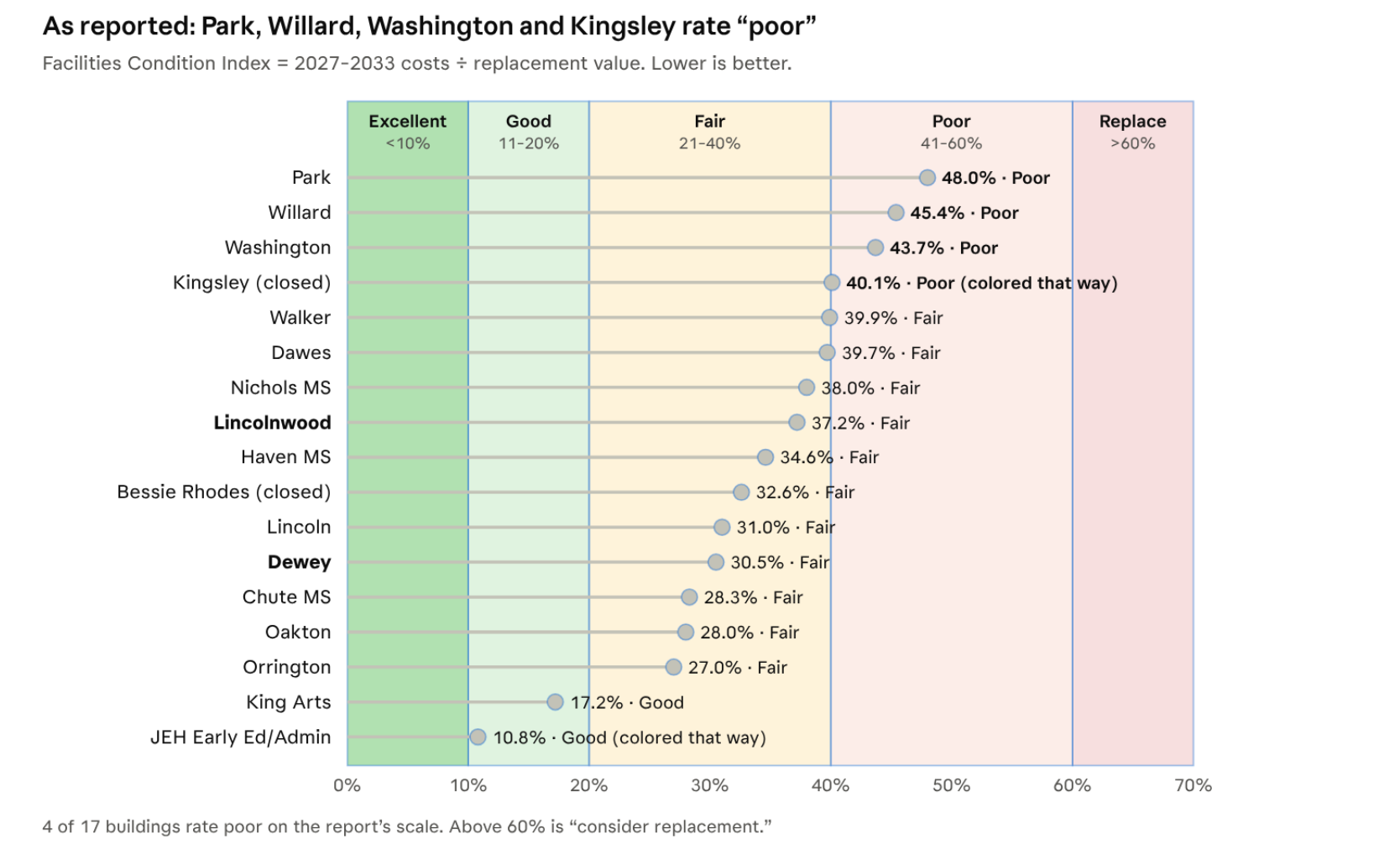
The score, and the resulting rating for each school, is simply the 2027–2033 costs divided by the replacement value. These scores look bad! And the district's aging buildings undoubtedly will continue to need repairs in the near and long term. But the costs are stated in nominal (inflated) dollars, whereas the replacement value is stated in 2025 dollars. Federal guidelines state that "nominal and real values must not be combined in the same analysis" [8]. Using an inflated number in the numerator makes the ratings seem much worse than they are, by an amount that depends on the arbitrary date range chosen. Each additional year a cost is pushed out inflates it by another 4.5%. If these costs are placed in 2025 dollars, we get:
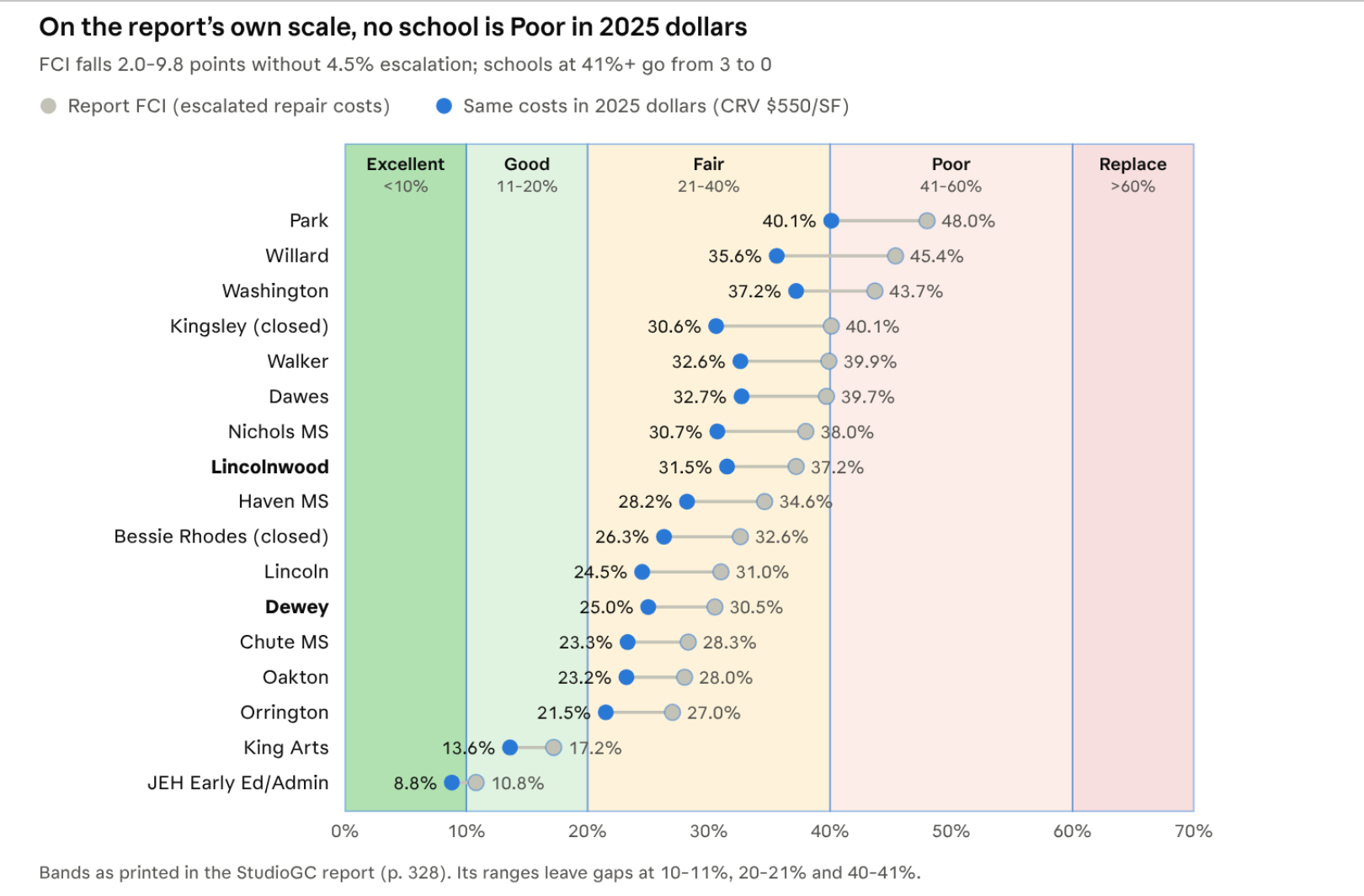
No school is clearly "poor" anymore.
Willard, Washington and Kingsley move to fair.
Park moves to the boundary between fair and poor.
JEH Early Ed/Admin moves up to excellent.
This recalculation of the same data makes the situation for the district's schools seem much less dire.
The illusion of school scorecards
The administration also relied on inflated dollars when calculating the scores used to decide which schools to close. Here is the scorecard the administration produced [10]:
School | Equity (31%) | Geography (32%) | Building (16%) | Costs (21%) | Total |
Lincolnwood | 2.3 | 1.8 | 1.2 | 4.2 | 2.4 |
Washington | 3.8 | 1.0 | 4.1 | 1.4 | 2.4 |
Dewey | 2.9 | 1.1 | 4.0 | 4.2 | 2.8 |
Oakton | 4.0 | 1.5 | 3.4 | 3.0 | 2.9 |
Dawes | 3.1 | 2.2 | 2.9 | 4.0 | 3.0 |
Willard | 1.3 | 3.1 | 4.3 | 4.4 | 3.0 |
Walker | 2.9 | 2.4 | 2.8 | 4.4 | 3.0 |
King Arts | 5.0 | 1.8 | 5.0 | 1.3 | 3.2 |
Orrington | 1.2 | 5.0 | 1.1 | 5.0 | 3.2 |
Lincoln | 3.3 | 2.9 | 5.0 | 3.0 | 3.4 |
District 65 FY27 Baseline Scorecard, October 5, 2026. Each category is scored from 1 to 5; the lowest total is the most likely to be recommended for closure. Income Potential is weighted at 0% and omitted.
Even though Washington and Lincolnwood were ranked lowest, the administration has chosen Dewey over Washington because Dewey has the lowest enrollment in the Nichols feeder pattern and the fewest classrooms (by one) [11]. But the part of the scorecard that incorporates capital expenditure costs uses StudioGC's 49-year nominal totals instead of real values in today's dollars: the capital expense figures in the scorecard match the report's totals exactly for all ten schools [4][10]. This means that the scheduling of large improvements like geothermal affected each school's score. Work scheduled in earlier years carries a lower cost than the same work scheduled in later years, and between 29% and 42% of each school's capital figure is inflation alone. A different schedule for a single school could have changed the order. The following table shows the three lowest-scoring schools under StudioGC's schedule and under two hypothetical alternatives:
Schedule for the same work | Lowest | 2nd lowest | 3rd lowest |
As scheduled by StudioGC | Lincolnwood 2.36 | Washington 2.44 | Dewey 2.77 |
All of Lincolnwood's work scheduled for 2027 | Washington 2.44 | Lincolnwood 2.51 | Dewey 2.76 |
Oakton's mechanical system scheduled for 2040 instead of 2028 | Lincolnwood 2.36 | Washington 2.44 | Oakton 2.76 |
Totals recalculated from the district's published category scores and scoring formula [10], changing only the capital expense input. Costs from the StudioGC cost database [9], escalated at 4.5% a year to the year shown.
This demonstrates that the money illusion does not just affect perception; it can lead to a flawed methodology that, had a different work schedule been chosen in a 49-year architecture proposal, would have resulted in different scorecards for candidate school closures. Fortunately for Oakton, and unfortunately for Dewey, when all costs are deflated back to 2025 dollars, we get the same ordering as before:
Schedule for the same work | Lowest | 2nd lowest | 3rd lowest |
No inflation (all costs in 2025 dollars) | Lincolnwood 2.33 | Washington 2.44 | Dewey 2.75 |
Same method, with every school's costs in 2025 dollars.
None of what has been outlined in this analysis means the district's budget problem isn't real. But the numbers used by the administration to argue for closing schools should mean what they appear to mean. A $58M savings claim that shrinks to essentially nothing once inflation, unsold buildings and work beyond needed repairs are accounted for is not a sound basis for closing two schools. Neither is a $598M repair bill that is spread over 49 years and is really $396M in 2025 dollars, or a set of building ratings that compares inflated costs with uninflated replacement values. The same goes for a scorecard whose rankings depend on work schedules. Everyone in this debate, ourselves included, needs to be careful when quoting numbers: say what year's dollars they are in, what period they cover and what they include. Otherwise it is all just "lies, damned lies, and statistics," and the Board and the community are left to make a consequential decision without knowing what is actually true.
Based on this research and analysis, the administration's proposal leaves considerable uncertainty about how its figures were derived. It is the Board’s responsibility to closely scrutinize the data and other information it is being presented with before making such consequential decisions about the future of our children.
Sources
District 65 presentation to the board, October 13, 2026: https://meetings.boardbook.org/Documents/FileViewerOrPublic/1247?file=14549463
October 13, 2026 board meeting, at about 0:55, on Bessie Rhodes and Kingsley: "The combined yearly savings from the closure and consolidation of Bessie Rhodes and Kingsley is a combined 3 million dollars in yearly savings. Additionally, there's potential savings of 57 million in future maintenance savings over 20 years."
October 13, 2026 board meeting, at about 1:22, on Dewey and Lincolnwood: "we anticipate an annual ongoing savings of about 2.9 million, and 58 million in future maintenance savings."
StudioGC, District 65 Master Facilities Plan: https://meetings.boardbook.org/Documents/FileViewerOrPublic/1247?file=6407257
October 13, 2026 board meeting, at about 0:56, the presenter states: "included using new inputs from Studio GC master facility plan."
Superintendent Witherspoon on the 602 podcast, Episode 16, mentions "half a billion dollars worth of work now": https://www.602podcast.com/#episodes
Outside consultant Dr. Grossi, November 9, 2026 board meeting, at about 2:43: "$550 million or whatever the number is $500 million of capital needs each building had a significant amount of capital needs."
OMB Circular A-94, "Guidelines and Discount Rates for Benefit-Cost Analysis of Federal Programs" (1992): https://www.whitehouse.gov/wp-content/uploads/2025/12/a094.pdf
StudioGC facility assessment cost database for Evanston/Skokie District 65, “Detail by Year” (Client Version V B.2, dated 3.19.26; marked “Working Version,” printed November 13, 2026). Its per-building totals for Dewey and Lincolnwood match the published report.
District 65, FY27 Baseline Scorecard and Raw Values (October 5, 2026) and "Updated Scorecard Logic," from the Financial Sustainability Plan data hub: https://www.district65.net/about/budget-finance/financial-sustainability-plan
October 13, 2026 board meeting, at about 1:03 and 2:24, on the choice of Dewey.