20 Reasons this District 65 Closure Plan is a Bad Idea
Geothermal Energy and Blue Cross Blue Shield policies
I’ve had readers reach out and ask me to comment on the new District 65 financial plan and closures. This discussion is complicated because there are two different, but related threads here:
The Budget Projections (September 2026) - this projection is the bad news bomb that was dropped on the Board in September, claiming that the District needs $20 million in cuts immediately. It contains a lot of ugly charts but less in supporting evidence.
The School Closure/Boundary Plans (October 2026) - this plan involves closing two schools (Dewey and Lincolnwood) permanently, ending Head Start and SACC pre/after care programs, and resulting in a total reduction of 88 certified and 129 support staff.
The closures are difficult to discuss because the immediate critique to suggesting that closing schools is bad is, “well, how do you propose we find $20 million dollars?” - so we end up going in circles.
I’d like to present two arguments here: 1) the projection is a worst case analysis of unknown accuracy and 2) the closure plan is not a good solution to that. Let me first address what I consider to be the major issues with the financial projections from September:
There is an $11.4 million fiscal cliff in FY29 that is unexplained (slide 21). The projected deficit jumps from $3.86 million in FY28 to $15.26 million in FY29, an $11.4 million swing in one year. They don’t explain what this is.
FY29 is the first year of a new DEC contract — are they just assuming the negotiations go poorly?[Update 10/25: The fiscal cliff here is actually a +$4 million dollar double counting error detailed in this Roundtable story]The $598.2 million ($395.6 million in 2025 dollars) in building repairs over the next 49 years makes extreme cost assumptions (my story). The District treats this like an immediate need, but it includes pipe-dream stuff like spending $100 million to add geothermal powered HVAC in 2034. The District admitted they’re using the maximal estimates in order to lock in funding: “the cost estimates have been developed using the most expensive of the three options (geothermal) to reflect the District commitment to sustainability, the strongest return on investment and to capture the maximum funding needed.” This raises the question: Is this estimate a staff wishlist or real repairs needed?
The estimate of +12% annual increase in healthcare cost is an assumption based on one year. On Slide 19 of the September 14 presentation, the new CFO took the prior CFO’s FY28-30 +6% annual healthcare cost assumption and doubled it to 12% compounding every single year through 2032 (a 76% increase!). Maybe this will happen but you can make any future budget look bad by compounding benefits costs this way.
Cook County Tax Assessor’s problems (story) are treated as structural and forever. The listed revenue shortfalls include lost interest earnings: about $2M, which the CFO tied to the low fund balance and county tax delays. They call this “conservative cash and rate assumption.” But the county portion should end — new system went live this summer, and county officials said this week they’re close to fixing the remaining problems. Do the projections assume the delays continue indefinitely?
The budget includes new spending. The October package is $20.87M in gross cuts, but it includes $5.5 million of new spending ($4.7 million capital, $0.8 million in teaching) and $1 million in implementation costs related to closing buildings. The rest goes to rebuilding reserves and pre-funding the gaps above. They may be reasonable expenses, but they’re choices.
The plan ignores new revenue opportunities. The October package includes just $565K in new revenue (student fees, Medicaid, grants). Meanwhile, the City of Evanston has offered two strategies, including extending a TIF that could help pay off Foster’s $3.25 million/year lease debt.
If the intent is to generate the most conservative (e.g. high cost) budget possible, they’ve done it. It assumes the bad things continue to be bad forever, assumes maximal facilities costs (geothermal energy), and call it “base case”. It’s not the worst idea — District 65 is constantly facing budget surprises and I suspect the Board is tired. However, the Board isn’t being presented a range of potential outcomes or even decisions. Instead, they’re being presented with a single projection — one that is much more conservative than projections given to them six months ago.
The District administration has a bad track record with projections. Below is a chart from 2019 - 2026. On average, their budgets are off about ± $5.7 million a year. Some years the misses are huge - in FY24 they were short by $8 million. In FY25 they were over by +$12.5 million after laying off administrators.
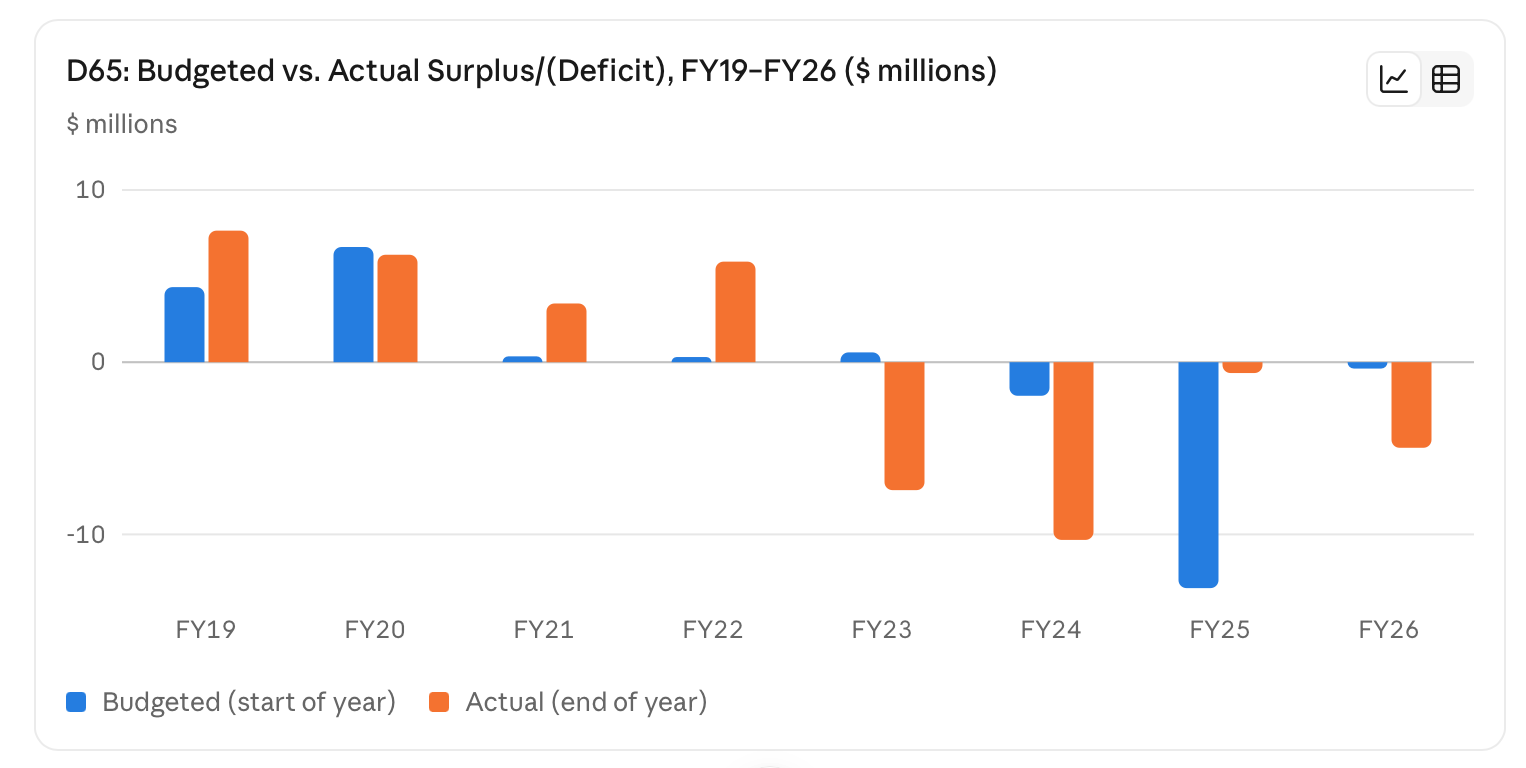
I recognize the District has a new CFO this year, but we’ve had new CFOs before. I’m not sure why this projection should be more reliable than any other prior one.
Closure Plans
Now let’s talk about the closure plan to address the above projection. Some of these are a feedback loop to the financial plan, such as busing or STEP, and the District treats these like pure savings when many of them may end up being costs.
The new boundaries don’t make any practical sense. I wrote about it. Kids living next to Washington will have to literally walk past it on their way to Dawes. Fifth ward kids will be bused to Lincoln. The new “October 23rd boundary proposal” doesn’t resolve any of the issues I raised such as Washington or Lincoln.
The move of STEP from Lincolnwood → Orrington is an issue. By the administration’s own admission, Orrington lacks suitable special education facilities compared to other buildings. In October 2025, the D65 administration admitted this, “We did also consider moving the STEP program to Orrington. Willard’s physical plant is kind of—has a stronger educational quality to it. Orrington does have basement classrooms and things along those lines.”
Speaking of STEP, the District has budgeted $0 to configure Orrington for STEP. Neither the $1.0M implementation allowance nor the Summer 2027/2028 Capital Plan budgets a single dollar for Orrington STEP renovations. (Orrington basement p149)
If STEP lands in Orrington’s basement, it will increase the issues with special education outplacement costs (D65 spent ~$6M in 2026 on special ed outplacements). They will be outplacing more, not fewer students when parents discover the situation and the District’s own admissions this is not a suitable space (ADA accessibility, missing bathrooms, etc) for their students.
The advertised savings from closing the two schools are potentially overstated. On Slide 35, the administration claims $2.9M in combined annual savings from closing Lincolnwood ($1.42M) and Dewey ($1.48M). Most of that figure ($1.82 million) is staffing reductions, leaving only $1.08 million across both campuses ($522K at Lincolnwood and $554K at Dewey). That $1.08 million is overstated since the District plans to retain both properties, which will require continued upkeep. Back in March, the District admitted, “We will obviously continue to have pretty significant utility costs and maintenance costs on those buildings for landscaping, alarms, all those different things. And so we're averaging that it's about a 60% of the overall cost.”
No Audit of Prior Closure Savings: On August 31, 2026 Board members asked CFO Eric Miller how much District 65 actually saved from closing Kingsley and Bessie Rhodes. Miller admitted: "I have not done an autopsy on just yet." On September 14, board members again asked for the actual savings from the reductions and the Kingsley closure; no figures were presented.
The staffing savings ($1.82 million) aren’t guaranteed either. District 65’s contract with the teachers’ union sets class-size goals of 23 students in K-2 and 25 in grade 3-5. Closing a school saves a teacher only where combining grades eliminates a class section, and the district hasn’t said which positions make up the $1.82 million
If they are successful, cutting around 100 teachers and support staff (excluding head-start and SACC layoffs) will have a negative impact on student achievement. It’s not clear to me how “rightsizing” the District and terminating around ~8% of instruction staff will improve conditions for any student. Class sizes will increase. There’s no “one simple trick” to improving achievement that involves removing that many educators.
The busing costs of these new boundaries are currently unknown. The October presentation slides contain the following disclaimer “Potential for additional transportation costs; subject to final enrollments, routing and efficiencies" — if you look at the boundaries, you’ll see there are some considerable busing costs not yet planned, such as kids from the Fifth Ward to Lincoln.
A referendum is likely dead on arrival. In the closure plan is a proposed referendum on the November 2028 ballot to fund "two new or fully renovated elementary schools." Surprising Dewey and closing four schools over three years (Bessie Rhodes, Kingsley, Dewey Lincolnwood) along with disrupting everyone else, they have alienated the coalition of voters needed to pass a bond referendum. I don’t see any way this would pass now.
Speaking of building repairs, this proposed plan does nothing to address the school with the worst condition score and short-term needs ($3.5M), that also houses the most at-risk students, Park School.
The District has omitted their own required pre-decision equity analysis (REIA). By their own admission; "The District will continue to engage in the REIA to quantify and document the work as part of the operationalization of the approved scenario." What’s the point of a board-policy-mandated equity analysis if it’s done after the fact?
Splitting Dewey into four parts is deeply disruptive to families. I can understand a one-to-one or a split-in-half boundary, but splitting the school into fourths is so disruptive to kids and families.
This forces former Kingsley students at Lincolnwood into their third school in three years. Closing Lincolnwood in July 2027 forces those children to change schools twice in two years (3 schools in 3 years). This is downright cruel to these kids.
What should District 65 do?
I think it’s clear that the Board doesn’t have enough information to make a decision. There are two main issues:
What does a realistic FY28-FY32 budget look like? What assumptions are baked into the FY29 projection?
Has the administration fully modeled out the impact of the closures? This includes busing costs, special education costs, realistic staffing reductions, and a genuine equity analysis. Is this worth the cost/benefit?
We’ll find out more at tomorrow night’s Board meeting.